
How founders and product leaders turn early validation into scalable, reliable and economically sustainable product growth.
MVP teams are rewarded for speed, learning and focus. A small team can take pragmatic shortcuts, rely on founder context and build directly for a narrow customer set. Before product-market evidence exists, those behaviors can be exactly right.
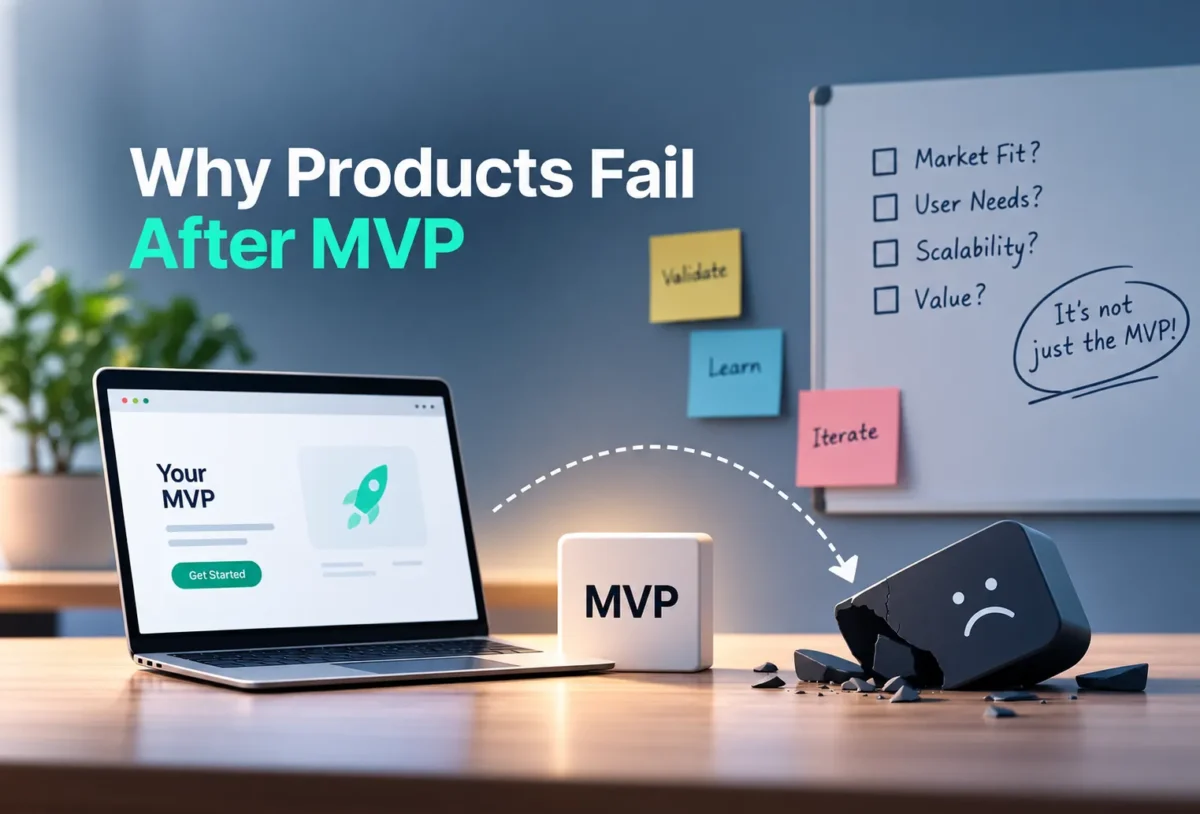
The problem begins when the organization keeps operating the same way after traction. Customer variation grows. Integrations multiply. Enterprise buyers expect security, uptime, auditability and data isolation. Support demand rises, and engineers spend more time maintaining exceptions and less time improving the product core. This is the heart of why products fail after MVP, and it is rarely a problem of ideas. It is a problem of operating model.
SYNAPLAB principle: The MVP should optimize for learning. The scale-up product should optimize for repeatability. Confusing these two stages creates technical debt, customer complexity and economic drag.
At Synaplab, we see this pattern across startups and scaling enterprises alike. Many of the same root causes also explain why technology strategies fail more broadly: the organization changes stage, but its habits do not.
MVP Success Does Not Prove Product Scale
An MVP may prove that a customer problem exists, that users will try the solution and that someone will pay. It does not prove that:
- the market is broad enough,
- customers will tolerate outages,
- the architecture can absorb many variants,
- a larger engineering organization can evolve the product, or
- unit economics remain attractive.
The post-MVP inflection is therefore a change in operating model: the company moves from proving demand to proving repeatability. Product, engineering, sales and customer success all need to change behavior.
The SYNAPLAB Post-MVP Product Scale Framework
Our framework looks at eight dimensions that determine whether early traction becomes durable growth: Product Core (common value), Variation (controlled flexibility), Architecture (safe evolution), Trust (enterprise readiness), Data (trusted scale), Operations (repeatable delivery), Economics (healthy margins) and Organization (sustainable execution).
| Dimension | Executive question | Scale outcome |
|---|---|---|
| Product core | What should be common for every customer? | Leverage |
| Variation model | What changes by customer without forking? | Controlled flexibility |
| Architecture | Can teams change the product safely? | Scalable evolution |
| Trust | Can enterprise customers rely on security and uptime? | Enterprise readiness |
| Data | Are ownership, isolation and analytics scalable? | Trusted intelligence |
| Operations | Can the product be deployed and supported repeatedly? | Reliable growth |
| Economics | Does cost-to-serve improve with scale? | Healthy margins |
| Organization | Can teams own outcomes without founder dependency? | Sustainable execution |
Framework rule: Before building a customer-specific requirement, classify it as core product, configuration, extension, integration or true exception. The classification should drive architecture, pricing and roadmap treatment.
12 Reasons Products Fail After MVP
1. Founder Knowledge Cannot Remain the Architecture
In early teams, founders and founding engineers often carry product rules, domain knowledge and architectural intent in their heads. That creates speed until every major technical decision waits for one person.
Scale requires converting implicit knowledge into product principles, domain models, architecture decisions, tests, documentation and delegated decision rights. If you lack senior technical leadership to make that shift, a fractional CTO can provide it without the cost of a full-time hire. Our guide to fractional CTO vs full-time CTO explains when each model fits.
2. Every Customer Cannot Become a Custom Build
Early customers frequently shape the product, but exceptions become dangerous when they turn into the default sales model. Customer-specific branches, unique workflow logic, private integrations and deployment differences expand the QA matrix and slow the core roadmap.
Variation should be expressed through configuration, extensions and stable integration mechanisms where possible. True exceptions should be explicit, priced and minimized.
3. A Scalable Product Needs a Clear Product Core
The product core should define common domain rules, user journeys, data models and platform capabilities. Around that core, leaders should deliberately design configuration points, extension interfaces and external integrations.
Without this distinction, roadmap decisions become customer-by-customer negotiations and the architecture fragments around the loudest request.
4. Architecture Must Absorb Growth Without Premature Complexity
Prototype architecture often optimizes for one team and one customer profile. Growth adds more teams, releases, customers, integrations and regions. Shared ownership collisions, performance issues and regression scope then rise quickly.
Post-MVP architecture should strengthen modularity, domain boundaries, APIs, events, testability, observability and clear data ownership. Scale-ready does not automatically mean microservices. A modular monolith can remain a strong choice when boundaries are clear and deployment simplicity still creates value.
This is where deliberate digital product architecture and platform transformation pays off. For a deeper look at architecture as a living discipline, read enterprise architecture beyond the target state, and see how we applied these principles in an enterprise application modernization case study.
5. Multi-Tenancy and Data Architecture Become Product Decisions
B2B SaaS teams often discover too late that tenant identity, authorization, isolation, noisy-neighbor protection, data retention, deletion, backup and analytics affect the entire architecture.
The multi-tenant model should be intentional and reflected in product tiers, operations and economics. Enterprise requirements may justify hybrid isolation models rather than one universal pattern.
6. Enterprise Readiness Should Arrive Before Sales Friction Becomes Structural
Enterprise buyers may require SSO, RBAC, delegated administration, audit logs, data export, security evidence, availability commitments, API stability and privacy controls. Building every capability before demand exists is wasteful, but ignoring likely enterprise needs can make later adoption expensive.
The practical goal is architectural room: preserve the ability to add enterprise capabilities without rewriting the product. Our cybersecurity, privacy, compliance and digital resilience practice helps teams build that room early, and the principles in cyber resilience by design show how to make security part of the product rather than an afterthought.
7. Quality Debt Becomes Roadmap Debt
When automated testing, code quality and release safety lag behind growth, manual regression expands, bug fixes displace roadmap work and senior engineers spend more time firefighting.
Quality practices, static analysis, feature flags, test-data strategy and clear quality ownership should mature before the organization scales around unstable foundations.
8. Reliability Becomes Part of the Product Promise
Design partners may tolerate outages that enterprise customers will not. Growth requires service ownership, observability, incident management, recovery, capacity planning and service-level objectives for critical journeys.
Reliability is not an infrastructure side topic. For enterprise SaaS, uptime, recovery and support are product functionality.
9. Product Discovery Must Continue After MVP
Initial traction does not freeze the market. New segments behave differently, users may adopt features in unexpected ways and value may concentrate in a narrower workflow than the roadmap assumes.
Customer research, usage analytics and outcome measurement should continue after MVP. The organization must scale the learning system, not only the delivery system.
10. Product Economics Must Include Technology Cost
Some customers consume disproportionate infrastructure, AI inference, support, implementation, compliance or integration capacity. If pricing ignores cost-to-serve, growth can reduce margin.
Leaders should measure meaningful cost drivers by customer segment or workload class when pricing and packaging depend on technical consumption. For more on connecting spend to outcomes, see cloud economics in the AI era and ask whether your technology investments are creating business value.
11. Integrations Should Expand the Product, Not Contaminate the Core
Point-to-point integrations create hidden product complexity when authentication, mapping, versioning and partner logic vary for every customer.
Stable APIs, events, webhooks, adapters and integration governance create a reusable connectivity model and protect the core domain from partner-specific logic.
12. Team Structure Must Evolve with Product Complexity
The founding team can successfully own everything for a period of time. As product areas, shared capabilities and support obligations multiply, durable ownership, platform teams and staff/principal technical leadership become necessary.
Founder escalation overload is a signal that decision rights and organization design have not evolved with the product. Our engineering organization, talent and global delivery transformation services help leaders redesign team topology and ownership for the next stage of growth.
Platform Engineering Creates Leverage After MVP
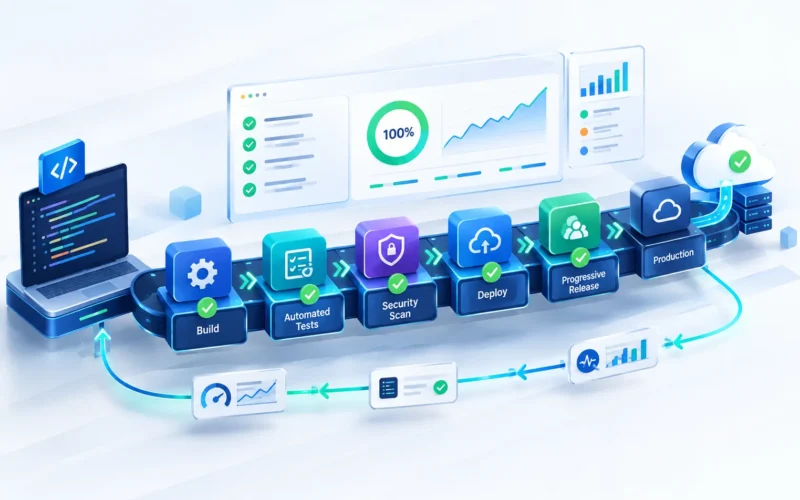
As the product organization grows, repeated engineering work becomes expensive. Service templates, CI/CD, environment provisioning, identity and secrets, observability, feature management, API and event infrastructure, and developer portals can become shared platform capabilities.
The goal is not internal tooling for its own sake. Platform engineering should reduce repeated work and make the preferred engineering path easier to follow.
AI-Enabled Products Need the Same Scale Discipline
AI can improve product experiences and engineering workflows, but AI features introduce additional concerns: model quality, evaluation, cost, latency, context management, security, privacy and operational fallback.
Post-MVP AI capability should therefore be governed as part of the product platform and economics rather than treated as a collection of isolated experiments. Explore our AI, data and intelligent enterprise transformation services, and read more on agentic AI governance and agentic AI workflow design.
A Practical Post-MVP Roadmap: The First 90 Days and Beyond
Days 1–30: Establish Post-MVP Truth
Map the product core, customer variation, architecture, quality, reliability, economics and organization so leadership shares one honest view of where the product stands.
Days 31–60: Define the Scale Model
Define the configuration and extension strategy, target architecture, enterprise roadmap, product metrics and ownership. A clear technology vision and roadmap keeps these decisions aligned, and our guide on how to build a technology strategy that delivers business value shows how.
Days 61–90: Fix the Highest-Leverage Constraints
Tackle the constraints that unlock the most progress, for example one customization pattern, one reliability bottleneck and one platform or golden path.
Months 4–18: Mature the Platform and Operating Model
Mature multi-tenancy, testing, observability, security, integration capability, team topology, enterprise administration, SRE, pricing, versioning, AI capability and product economics.
Post-MVP scale rule: After MVP, optimize for repeatability before breadth: repeatable customer value, repeatable implementation, repeatable delivery and repeatable economics.
Frequently Asked Questions
Why do products fail after MVP?
Most products fail after MVP because the organization keeps operating in learning mode after traction arrives. Founder-dependent knowledge, customer-specific builds, fragile architecture, weak quality practices and ignored cost-to-serve all compound as customers, integrations and enterprise expectations grow.
What is the difference between an MVP and a scalable product?
An MVP optimizes for learning: it proves a problem exists and that customers will pay. A scalable product optimizes for repeatability: repeatable customer value, implementation, delivery and economics.
Do I need microservices to scale my product after MVP?
No. Scale-ready does not automatically mean microservices. A modular monolith with clear domain boundaries can remain a strong choice, especially when deployment simplicity still creates value.
When should a startup invest in enterprise readiness?
Before sales friction becomes structural. You do not need to build every capability up front, but you should preserve architectural room so that SSO, RBAC, audit logs and data controls can be added without rewriting the product.
Turn Early Traction into Scalable Growth
The transition from MVP to scale is where many promising products stall. If you are navigating customer variation, architecture limits, enterprise expectations or margin pressure, our team can help you build a roadmap that fits your stage. Explore our full range of technology services, browse our case studies, learn more about Synaplab, or contact us to discuss your product’s next stage.
Looking for more perspectives? Visit our Insights hub.