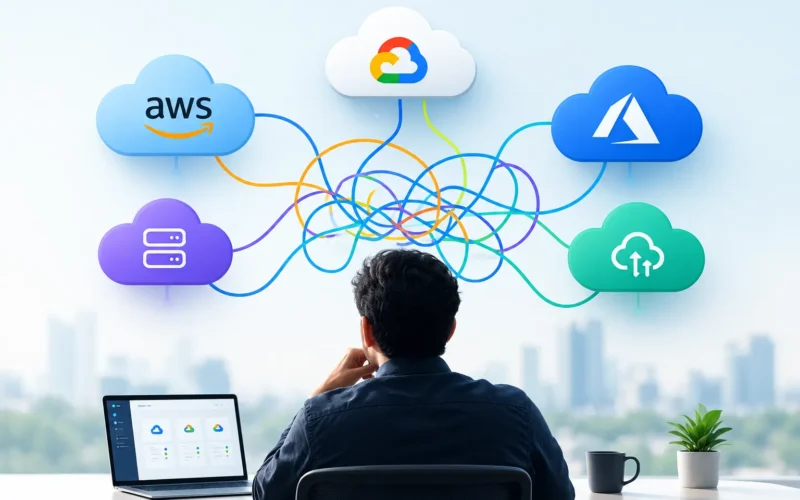

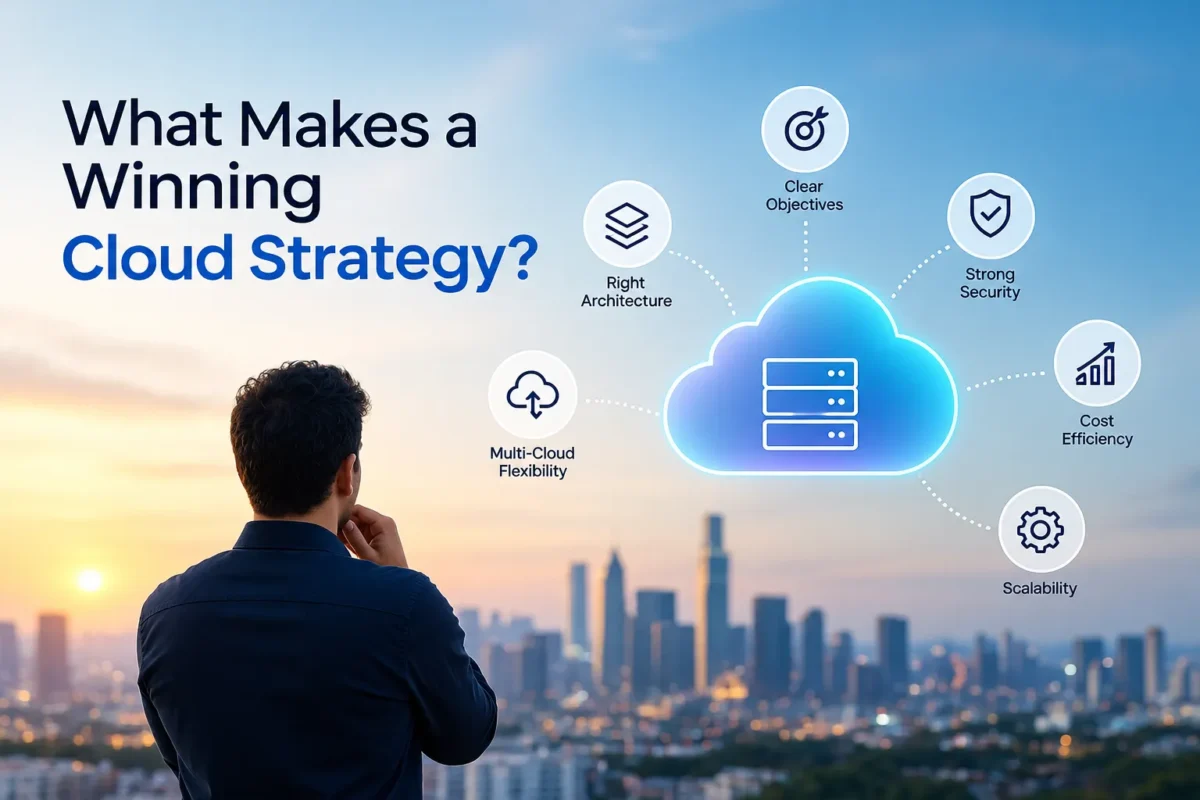
From cloud adoption to a secure, governed and measurable technology platform.
A winning cloud strategy is not a migration plan. It connects business priorities with workload decisions, cloud foundations, architecture, economics, engineering, operating experience and measurable outcomes.
Most organizations no longer need to be convinced that cloud matters. The harder question is whether the cloud estate they have built is actually helping the business move faster, modernize safely, control risk, recover reliably and support new data and AI demands.
Cloud strategy therefore needs to move beyond provider selection and migration sequencing. It should define how the organization makes workload decisions, establishes reusable foundations, chooses services, governs cost and risk, and builds an operating model that can evolve as business priorities change.
1. Start with Business Strategy and Expected Outcomes
The first question should not be which cloud to use. It should be what the business needs technology to enable.
- Faster product or service launches
- Expansion into new markets or operating regions
- Modernization of legacy applications and data
- Higher resilience and stronger recovery capability
- More consistent security and compliance
- Improved engineering productivity and release speed
- AI and data workloads that can move from experimentation to production
- Better visibility and control of technology cost
Those outcomes should shape the architecture. A cloud program that cannot explain the business result it is intended to create is at risk of becoming an infrastructure exercise.
2. Decide What Should Migrate, Modernize, Remain or Retire
Not every workload deserves the same cloud treatment. Business value, technical fitness, dependencies, lifecycle risk, data requirements and modernization potential should be considered together.
| Decision | When it may fit | Leadership question |
|---|---|---|
| Retain | The current environment remains fit for purpose | What value would change actually create? |
| Migrate | Relocation creates value without major redesign | Can the workload move with acceptable risk and economics? |
| Re-platform | Managed services or platform changes improve operations | Can maintainability improve without full refactoring? |
| Refactor | Business value justifies deeper modernization | Which architectural constraints are limiting growth or delivery? |
| Replace | A strategic product or SaaS platform is more appropriate | Should the organization continue owning this capability technically? |
| Retire | The workload is duplicate, obsolete or low value | What complexity and cost can be removed? |
The goal is not maximum migration. It is the right placement and modernization path for each workload.
3. Establish a Repeatable Cloud Landing Zone and Platform Foundation
A cloud landing zone is the reusable foundation on which workloads can be deployed and governed consistently. It should reduce the need for each project to rebuild identity, environment structure, policy, logging, security and operational controls from scratch.
- Account, subscription, project and environment structure
- Identity, privileged access and role design
- Policy, guardrails and resource standards
- Central logging, monitoring and management
- Shared platform services and environment separation
- Automation and Infrastructure as Code
- Tagging, cost ownership and lifecycle controls
- Baseline resilience and recovery expectations
A useful test is simple: can a new workload land on a secure, governed and repeatable platform without rebuilding the same foundations every time?
4. Treat Networking and Connectivity as Part of the Strategy
Networking is often treated as an implementation detail. In practice, it influences application connectivity, hybrid integration, data movement, security, resilience, latency and cloud economics.
- Hybrid and private connectivity
- Network topology and segmentation
- Routing, DNS and service discovery
- Ingress, egress and traffic inspection
- Private endpoints and service connectivity
- Cross-region and cross-cloud communication
- Latency, bandwidth and data-transfer cost
- Network observability and operational ownership
If networking is solved independently by every workload, the cloud estate becomes harder to operate as it grows. The foundation should provide clear patterns while still allowing justified exceptions.
5. Make Cloud-Native and Third-Party Service Choices Deliberately
Vendor neutrality does not mean avoiding cloud-native services. It means choosing technology because it creates the best business and architectural outcome, not because a provider or product was predetermined.
| Decision factor | Cloud-native may fit when | Third-party may fit when |
|---|---|---|
| Capability | The provider capability is mature and differentiated | A specialist product offers materially stronger capability |
| Integration | Tight platform integration reduces complexity | Consistency across multiple platforms matters more |
| Portability | There is no credible portability requirement | Portability or cross-cloud consistency is strategically important |
| Operations | Teams already operate the cloud platform effectively | A common enterprise control plane reduces fragmentation |
| Security & governance | Native controls align closely with the workload | Central policy or assurance must span several environments |
| Economics | Consumption and licensing are simpler or lower cost | Enterprise licensing or consolidation provides better economics |
| Skills | Existing skills align with the cloud platform | The specialist tool matches established enterprise capability |
| Exit risk | Switching cost is acceptable relative to value | Exit flexibility is a material business requirement |
The objective is not native-first or third-party-first. It is intentional architecture with a clear rationale for capability, operating effort, risk, portability and total cost.
6. Build Security, Compliance and Sovereignty into the Foundation
Security and compliance become expensive when they are retrofitted after workloads have already scaled. Identity, data protection, configuration policy, logging, vulnerability management, regulatory requirements and exception handling should be designed into the cloud operating model.
For regulated or geographically distributed organizations, data residency, jurisdiction, operational control and exit requirements may also affect workload placement. These decisions should be explicit rather than discovered late in delivery.
7. Treat Cloud Economics as an Architecture and Leadership Concern
Cloud cost is shaped by architecture. Availability models, storage choices, data movement, managed services, licensing, environment design and engineering behavior all influence consumption.
A mature strategy therefore connects FinOps with architecture and portfolio decisions before cost is committed. Leadership should be able to see who owns a workload, what it costs, how that cost is changing and what business value the workload supports.
The objective is not simply to spend less. It is to improve the economics of technology.
8. Design Resilience and Operations for Real Failure
Running in the cloud does not automatically make a system resilient. Availability, recoverability and operational readiness need to be designed and tested.
- Clear business-aligned recovery objectives
- Dependency visibility across applications, data and shared services
- Backup, replication and disaster-recovery design
- Observability, alerting and operational runbooks
- Failover and recovery testing
- Ownership for incidents, escalation and recovery decisions
A system that has never been tested under failure has not yet demonstrated resilience.
9. Use Engineering, Automation and Platform Capabilities to Improve Delivery
Cloud creates more value when teams can consume secure, reusable capabilities instead of repeatedly solving infrastructure problems themselves.
- Infrastructure as Code and policy automation
- CI/CD and release automation
- Reusable platform services and templates
- Self-service with embedded guardrails
- Observability by default
- Standardized environment patterns
- Platform engineering where scale and reuse justify it
The stronger the platform foundation, the less time product and application teams should spend rebuilding commodity capabilities.
10. Design the Operating Model and the Operating Experience
Cloud transformation changes responsibilities as much as technology. Architecture, engineering, operations, security, finance, business teams and partners need clear ownership and decision rights.
| Perspective | What a good cloud operating experience should improve |
|---|---|
| End users | Reliability, responsiveness and simpler business workflows |
| Business SMEs | Access to information and processes without unnecessary technology friction |
| Engineering teams | Faster provisioning, deployment, self-service and reusable platform capabilities |
| Operations teams | Observability, supportability, recovery and clear ownership |
| Administrators | Consistent access, policy, environment management and governance |
| Leadership | Transparent risk, cost, progress and measurable outcomes |
A cloud program can be technically successful while making day-to-day work harder. If scalability improves but the operating experience deteriorates, the transformation is incomplete.
11. Measure Outcomes, Not Cloud Activity
Migration counts, resource counts and platform adoption are useful operational indicators, but they are not business outcomes by themselves.
- Time to launch or change products and services
- Application modernization progress
- Deployment speed and predictability
- Service availability and recovery performance
- Security and compliance posture
- Cloud cost, unit economics and forecast accuracy
- Platform reuse and engineering productivity
- Reduction in technical debt and duplicated capability
- Readiness for data, AI and future business workloads
A Winning Cloud Strategy: The End-to-End Decision Model
| 1 | Business Strategy & Outcomes: Define growth, modernization, resilience, customer, AI and financial outcomes. |
| 2 | Workload & Modernization Strategy: Decide what to retain, migrate, re-platform, refactor, replace or retire. |
| 3 | Landing Zone & Platform Foundation: Establish repeatable identity, organization, policy, management and automation foundations. |
| 4 | Networking & Connectivity: Design secure, observable hybrid, regional and cross-cloud connectivity. |
| 5 | Architecture & Service Choices: Make deliberate native, third-party, portability and provider decisions. |
| 6 | Security, Compliance & Sovereignty: Embed security, controls, data-location and operational-control requirements. |
| 7 | Cloud Economics & FinOps: Connect consumption, architecture and investment to accountability and business value. |
| 8 | Resilience & Operations: Design, test and operate for real failure and recovery scenarios. |
| 9 | Engineering & Platform Experience: Use automation, self-service and reusable capabilities to improve delivery. |
| 10 | Operating Model & Skills: Clarify ownership, decision rights, capabilities and partner roles. |
| 11 | Measurable Outcomes: Track value through speed, reliability, cost, risk, adoption and business outcomes. |
A winning cloud strategy connects business ambition with architecture, economics, engineering and operating reality.
Final Thought
Cloud strategy is not finished when workloads have moved. It is working when the organization can make faster technology decisions, modernize safely, control risk and cost, recover reliably and support new business and AI demands without rebuilding the foundation each time.
Frequently Asked Questions
1. What should a cloud strategy include?
A cloud strategy should connect business outcomes with workload placement, modernization, landing-zone and networking foundations, architecture and service choices, security, governance, FinOps, resilience, engineering automation, operating model and measurable outcomes.
2. What is a cloud landing zone?
A cloud landing zone is a repeatable foundation for deploying workloads with consistent identity, resource organization, networking, security, governance, management, automation and cost controls. The implementation should reflect the organization’s scale, risk and operating model.
3. Should we use cloud-native services or third-party tools?
There is no universal answer. Native services can reduce integration and operational complexity, while third-party platforms can provide specialist capability or consistency across clouds. The decision should consider business value, architecture fit, skills, portability, risk, licensing and total operating cost.
4. How important is networking in cloud strategy?
Networking is foundational because it affects application connectivity, hybrid integration, security, latency, data movement, resilience and egress cost. Network design should be part of the cloud foundation rather than solved independently by each workload.
5. How should AI change cloud strategy?
AI increases demand for accessible data, scalable compute, storage, networking, security, observability and cost governance. Organizations should assess whether their platform foundation can support AI workloads without creating uncontrolled cost, data fragmentation or new operational risk.
6. How do you know whether cloud strategy is working?
Measure business and technology outcomes such as time to market, deployment predictability, service reliability, recovery performance, platform adoption, cloud unit economics, security posture, technical-debt reduction and the business value enabled by new capabilities.