

Every founder eventually hits the same wall: the product is growing, the engineering backlog is a mess, and someone needs to own the technology decisions before they own you instead. The question that follows is almost always the same one — do you hire a fractional CTO or go all-in on a full-time CTO?
There’s no universal right answer. But there is a right answer for your stage, budget, and risk tolerance. This guide breaks down the real costs, the ROI math, and the signals that tell you it’s time to switch from one model to the other.
What’s the Difference Between a Fractional CTO and a Full-Time CTO?
A fractional CTO is a senior technology leader who works with your company part-time, usually 10 to 25 hours a week, spread across one or more clients. You get the strategic judgment of a seasoned executive without putting them on payroll.
A full-time CTO is a dedicated, salaried executive who works exclusively for your company. They own the engineering org day to day, sit in every leadership meeting, and are usually the technical face of the business to investors and customers.
Think of it like the difference between hiring a personal trainer for two sessions a week versus hiring a live-in coach. Both can get you fit. One costs a lot less and demands a lot more self-discipline in between visits.
It’s also worth separating fractional from interim — the two get confused constantly, and picking the wrong one under pressure tends to slow a company down rather than speed it up. If you’re weighing that distinction too, SYNAPLAB’s breakdown of fractional vs. interim CTO leadership is worth a quick read before you decide.
Fractional CTO vs. Full-Time CTO: The Core Differences
| Factor | Fractional CTO | Full-Time CTO |
| Time commitment | 10–25 hrs/week (part-time) | 40+ hrs/week (dedicated) |
| Annual cost | Roughly $60,000–$180,000 | Roughly $300,000–$600,000+ all-in |
| Equity | Usually none, or a small advisory grant | Typically 0.5%–5% depending on stage |
| Hiring timeline | Days to a few weeks | Often 3–6 months to recruit |
| Commitment risk | Low — cancel with notice | High — severance, backfill, culture cost |
| Best fit | Pre-seed to Series A, or narrow projects | Series A+ with a growing engineering team |
| Day-to-day ownership | Strategic guidance, oversight | Full operational ownership |
Neither column is “better.” They solve different problems at different stages of the same company.
How Much Does a Fractional CTO Cost?
Fractional CTO pricing usually comes in three shapes, and it helps to know all three before a sales call, because agencies rarely lead with numbers.
Hourly Rates
Most experienced fractional CTOs in the US charge somewhere between $150 and $400 an hour, with the bulk of the market sitting closer to $200–$300/hr. Rates climb toward $500+/hr for specialists in AI, fintech, or healthtech, and for due-diligence work ahead of a fundraise. If you see quotes under $100/hr, that’s usually a junior engineering manager wearing a CTO label, not an executive who has actually run an engineering organization.
Monthly Retainers
Retainers are the more common structure for ongoing work, because nobody enjoys watching a clock tick during a strategy conversation. Typical monthly retainers land between $5,000 and $15,000 for 10–20 hours a week, and can stretch to $20,000–$25,000 for near-full-time “embedded” engagements. As a rule of thumb, once you need more than roughly 30 hours a month, a retainer beats hourly billing by 25–40%.
Project-Based Pricing
For a defined deliverable — an architecture audit, a technical due-diligence report before a raise, a hiring plan for your first five engineers — project pricing typically runs $8,000 to $50,000+, depending on scope and complexity.
Annualized, a meaningful fractional CTO engagement usually totals $60,000 to $180,000 a year, with no equity dilution and no severance exposure if the engagement ends.
How Much Does a Full-Time CTO Cost?
Full-time CTO cost is where founders usually underestimate by a wide margin, because they mentally stop at base salary.
According to Glassdoor’s 2026 compensation data, the average base salary for a Chief Technology Officer in the US sits around $288,000–$332,000 a year, with the middle 50% falling between roughly $216,000 and $445,000 depending on company size and location. Startup-specific numbers run lower at the earliest stages — compensation research from Kruze Consulting puts average startup CTO base pay closer to $150,000–$160,000 at seed stage, rising toward $250,000–$350,000 by Series B.
But base salary is only part of the bill. A full-time CTO hire also brings:
- Equity — typically 0.5% to 5% depending on funding stage, which can be worth far more than cash if the company succeeds
- Bonus — often 15–30% of base at more mature companies
- Benefits and payroll taxes — generally adds 20–30% on top of base
- Recruiting cost — executive search fees often run 20–30% of first-year total comp
- Onboarding time — most new CTOs need three to six months before they’re fully productive
- Severance risk — if the hire doesn’t work out, you’re paying to exit as well as to enter
Once you stack all of that up, industry compensation guides consistently land on $300,000 to $550,000+ a year, fully loaded, for a well-qualified full-time CTO in the US — and that’s before a bad hire costs you a second search.
If the real gap is building out the engineering organization itself — not just the executive seat — it’s also worth looking at engineering organization and global delivery models, including GCC and distributed-team structures, before assuming a full-time CTO hire is the only fix.
The full-time CTO cost iceberg
The salary is the tip. Six more cost layers sit below it.
Sources: Glassdoor 2026, Kruze Consulting.
Fractional CTO Cost vs. Full-Time CTO Cost: The Side-by-Side Math
Here’s the comparison founders actually want to see.
| Metric | Fractional CTO | Full-Time CTO |
| Typical annual cost | $60,000–$180,000 | $300,000–$550,000+ |
| Equity dilution | None to minimal | 0.5%–5% |
| Hiring + onboarding time | Days to weeks | 3–6+ months |
| Savings vs. full-time | 60%–75% lower cash cost | — |
That 60–75% savings figure shows up consistently across independent pricing guides in 2026, and it’s the single biggest reason early-stage companies choose the fractional route first. The catch: a fractional CTO’s weekly hours are capped by design. If your engineering org needs 40+ hours a week of hands-on leadership, the math stops favoring “fractional” — you’re just paying part-time rates for a job that needs a full-time person.
Fractional CTO for Startups: When It Makes Sense
A fractional CTO tends to be the right call when:
- You’re pre-seed or seed stage and can’t yet justify a $300K+ salary line
- You need strategic direction, not daily execution — architecture decisions, a tech roadmap, vendor evaluation, investor-facing technical credibility
- You’re preparing for a fundraise and need a technical due-diligence story that survives investor scrutiny
- Your engineering team is small (under 5–8 engineers) and doesn’t yet need a dedicated executive layer
- You need a specific problem solved — a security audit, a cloud migration plan, a hiring roadmap for your first engineers — rather than ongoing operational ownership
If any of that sounds like your company right now, a fractional engagement gives you executive-level judgment at a fraction of the commitment. SYNAPLAB’s Fractional CTO services are built around exactly this stage — strategy, architecture ownership, and investor-ready technical direction without a six-figure payroll commitment.
When to Hire a Full-Time CTO
The signals flip the other way as the company grows. It’s usually time to hire full-time when:
- Your engineering team crosses roughly 10–15 people. Coordination, hiring, and performance management become a full-time job on their own.
- Technology is now the product, not a support function. If engineering velocity directly determines revenue, you need someone in the building every day.
- You’re fundraising at Series A or beyond, and investors expect a dedicated technical executive on the leadership team, not a part-time advisor.
- Decisions are piling up faster than your fractional CTO’s hours allow. If your part-time leader is constantly triaging instead of leading, that’s the tell.
- You need someone accountable for culture, not just architecture. Full-time presence builds engineering culture in a way part-time hours structurally can’t.
Where your company sits decides the model
Same question, different answer at every stage.
Pre-Seed
Fractional
<5 engineers
Seed
Fractional
5–8 engineers
Series A
Transition
8–15 engineers
Series B+
Full-Time
15+ engineers
Directional guidance, not a fixed rule.
How to Calculate Fractional CTO ROI
ROI on a fractional CTO isn’t just “cost saved versus a full-time salary.” It’s also risk avoided. A useful way to frame it:
ROI = (Value of mistakes avoided + value of decisions accelerated + cash saved vs. full-time) ÷ fractional CTO cost
What goes into fractional CTO ROI
Three value streams, stacked against one cost line.
Based on fractional-CTO market and compensation benchmarks, 2026.
In practice, the biggest ROI driver is usually mistake prevention. A rushed architecture decision, a security gap discovered post-launch, or a mis-scoped cloud migration can easily cost $50,000–$200,000 to unwind — often more than a full year of a fractional engagement. Industry benchmarks commonly cite fractional CTO ROI in the 3x–10x range once you account for avoided rework, faster fundraising, and better hiring decisions.
A simple gut-check: if your fractional CTO helps you avoid one bad technical decision, close one funding round faster, or make one smarter hire, the engagement has usually already paid for itself. For a deeper look at connecting technology spend to measurable outcomes, see are your technology investments creating business value.
Fractional CTO Break-Even: The Number That Matters
The break-even point isn’t really about hours — it’s about workload. As a working rule:
- Under 8–10 hours a week of technical leadership needed → fractional almost always wins on cost
- 10–25 hours a week → fractional retainer is usually still cheaper and more flexible
- 25–35+ hours a week, sustained for months → the math starts converging with full-time, and the conversation shifts from cost to commitment and culture
If you find yourself extending your fractional CTO’s hours every quarter, that’s not a pricing problem. That’s a sign you’ve outgrown the model — often for the same underlying reasons covered in why technology strategies fail: direction and execution capacity have quietly drifted out of sync.
Signs You’ve Outgrown a Fractional CTO
- Engineering decisions are now waiting on your fractional CTO’s limited weekly hours
- You’re hiring engineers faster than your part-time leader can onboard and manage them
- Board members or investors are asking why there’s no full-time technical executive
- Your fractional CTO is spending most of their hours on operations instead of strategy
- You’re paying for 25+ hours a week anyway, and it’s climbing every quarter
Fractional CTO to Full-Time Transition: How to Do It Right
The switch doesn’t have to be abrupt. A few approaches that work well in practice:
- Convert the fractional CTO. If the relationship has worked well, some fractional CTOs are open to a full-time offer — you skip the recruiting search entirely.
- Use the fractional CTO to hire their replacement. They know the technical bar you need and can run the search or evaluate candidates far better than a generalist recruiter.
- Run a transition overlap. Keep the fractional CTO on a reduced retainer for 4–8 weeks while the new full-time hire ramps up, so institutional knowledge doesn’t walk out the door.
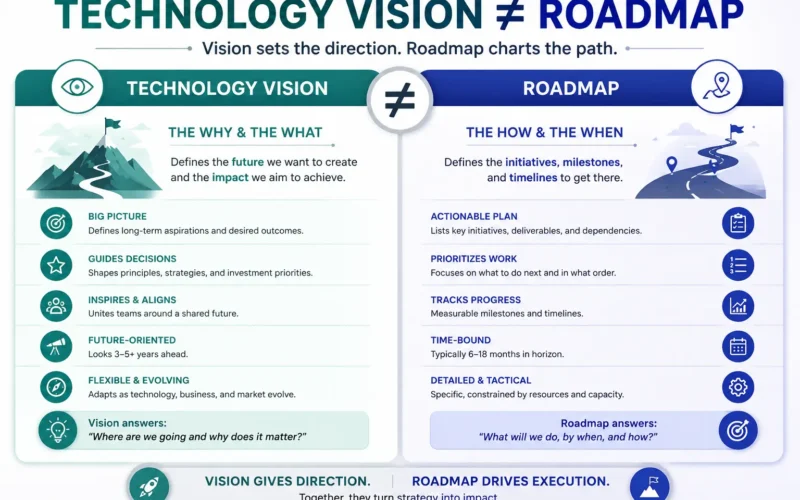
- Reassess scope, not just headcount. A full-time CTO’s job description should reflect what the company needs now — not just a bigger version of the fractional job description. This is also where the difference between technology vision and a roadmap tends to matter most, since a full-time hire needs both, not just one.
For a sense of how this plays out in practice, our technology strategy and transformation and digital transformation strategy case studies both walk through engagements that started with fractional-style advisory work before scaling into broader execution.
Should You Hire a Fractional CTO? A Quick Checklist
Fractional or full-time? Follow the path
Ask yourself these five questions:
- Do I need strategic direction more than daily execution? → Fractional
- Can I justify $300K+ in fully loaded annual cost right now? → If no, fractional
- Is my engineering team under 10 people? → Fractional
- Are investors specifically expecting a full-time technical executive? → Full-time
- Am I already paying for 30+ hours a week of fractional time? → Full-time
If you’re still unsure, that’s genuinely fine — most founders are. A short, structured technology assessment is usually faster and cheaper than guessing, and it gives you an objective read on where your company actually sits before you commit to either model. You can also browse the full range of SYNAPLAB’s service pillars or read more about the advisory team behind the recommendations.
Final Thought
There’s no prize for hiring a full-time CTO too early, and there’s no prize for staying fractional past the point where it’s holding you back. The goal isn’t picking the “correct” model in the abstract — it’s matching the model to what your engineering org actually needs this year, not the org you hope to have in three years.
If you want an outside, unbiased view of where you stand, SYNAPLAB offers fractional and interim CTO leadership, along with broader technology strategy, digital product and cloud platform, AI and data, and cybersecurity advisory support for companies figuring out exactly this decision.
You can browse real engagement outcomes in our case studies — including infrastructure and cloud consolidation and AI and data engineering work — read more perspective on the insights page, or start a confidential conversation about your specific stage. Details on how we handle any information you share are outlined in our privacy policy.
Frequently Asked Questions
1. Should I hire a fractional CTO or a full-time CTO for my startup?
It depends on your stage and workload. If you need strategic direction, architecture oversight, or investor-ready technical credibility for under 25 hours a week, a fractional CTO is usually more cost-effective. If your engineering team has grown past 10–15 people and technology decisions need daily, hands-on ownership, a full-time CTO typically makes more sense despite the higher cost.
2. How much does a fractional CTO cost compared with a full-time CTO?
A fractional CTO typically costs $60,000–$180,000 a year, billed hourly ($150–$400/hr) or via monthly retainer ($5,000–$15,000/month). A full-time CTO costs $300,000–$550,000+ a year once you include base salary, equity, bonus, benefits, and recruiting fees. Most companies save 60–75% in cash cost by going fractional first.
3. What is the ROI of a fractional CTO compared with a full-time CTO?
Fractional CTO ROI typically comes from three places: cash saved versus a full-time salary, faster and better technical decisions, and avoided architecture or security mistakes that can cost $50,000–$200,000 to fix later. Many engagements deliver an estimated 3x–10x return once avoided rework and accelerated fundraising are factored in.
4. When should a startup switch from a fractional CTO to a full-time CTO?
The usual trigger points are an engineering team crossing roughly 10–15 people, technology becoming the core product rather than a support function, investors expecting a dedicated technical executive at Series A or beyond, or a fractional CTO’s hours consistently maxing out with decisions backing up.
5. At what stage does a startup need a full-time CTO?
Most startups need a full-time CTO by Series A or Series B, once the engineering org grows past roughly 10 people and technical decisions require daily, hands-on ownership. Pre-seed and seed-stage companies can usually get equivalent strategic value from a fractional CTO at a fraction of the cost.
6. How do I calculate the ROI of hiring a fractional CTO?
Add up the cash saved versus a full-time hire, the estimated cost of technical mistakes avoided (architecture errors, security gaps, mis-scoped projects), and the value of faster decision-making or a stronger fundraising story. Divide that total by the fractional CTO’s annual cost. A result above 1x means the engagement is paying for itself.
7. How many engineers should a startup have before hiring a full-time CTO?
There’s no fixed number, but most companies see the need emerge once the engineering team passes roughly 10–15 people. Below that, a fractional CTO can usually provide sufficient strategic oversight without the cost and commitment of a full-time executive hire.
8. What are the signs that my startup has outgrown a fractional CTO?
Common signs include decisions queuing up while waiting for your fractional CTO’s limited hours, hiring engineers faster than they can onboard, investors asking about full-time technical leadership, and your fractional retainer creeping toward 30+ hours a week every quarter. Any of these usually signals it’s time to consider a full-time hire.
9. Is a fractional CTO worth it for a pre-seed startup?
Yes, for most pre-seed companies. A fractional CTO provides architecture direction, technical credibility for investors, and hiring guidance at a fraction of full-time cost — typically without any equity dilution. Pre-seed companies rarely have enough sustained technical workload to justify a $300K+ fully loaded full-time hire.
10. What are the hidden costs of hiring a full-time CTO?
Beyond base salary, full-time CTO hires typically add equity (0.5%–5%), bonus, benefits and payroll taxes (20–30% on top of base), executive recruiting fees (often 20–30% of first-year comp), a three-to-six-month ramp-up period, and severance risk if the hire doesn’t work out. These extras routinely push total cost well beyond the advertised salary figure.