

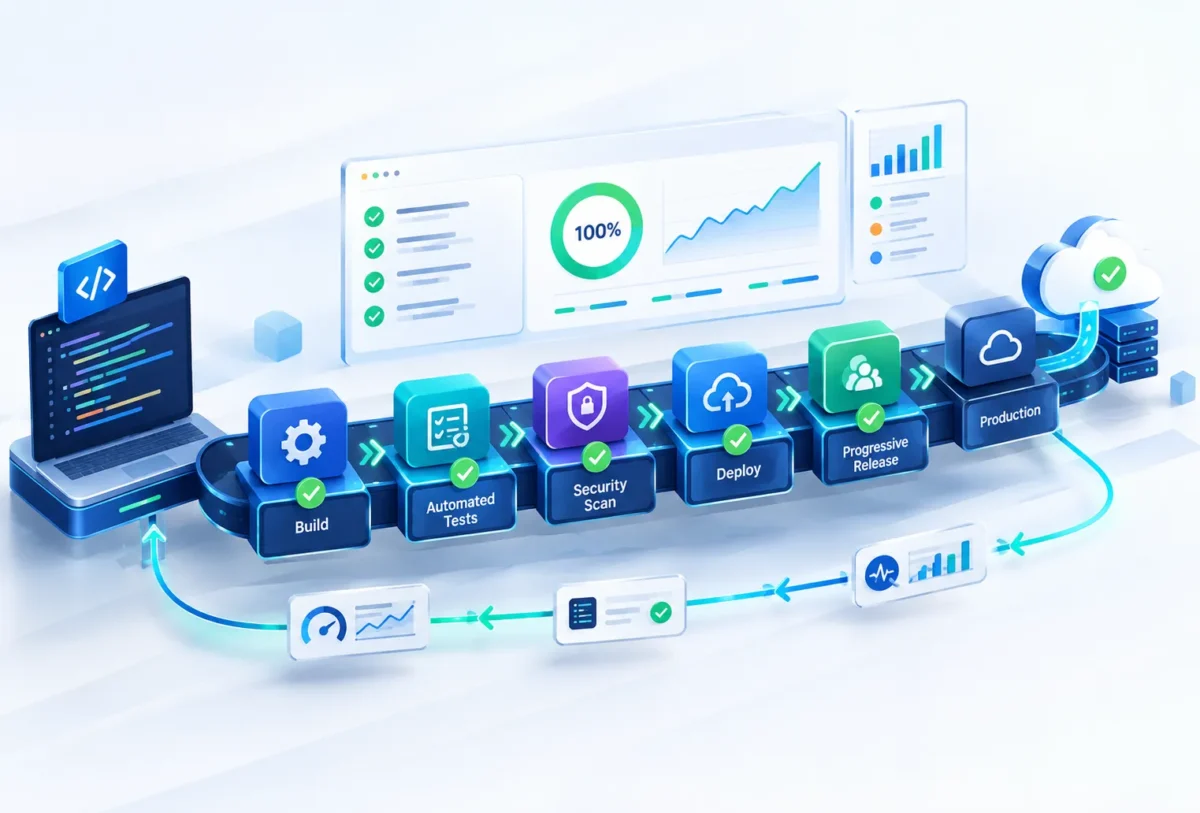
Engineering quality without slowing delivery is possible, but only when quality is treated as a property of the engineering system rather than a phase at the end. Many engineering organizations try to improve quality by adding more manual testing, approvals and stabilization time. That can reduce some visible failures, but it also increases batch size, lengthens feedback cycles and makes defects more expensive to discover.
The alternative is not weaker quality. It is a better engineering system, one in which evidence about correctness, security, reliability and operability is generated continuously and close to the point where a change is made.
SYNAPLAB principle: Quality is not a phase, a department or a release gate. It is a property of the engineering system.
This guide explains how engineering leaders can build quality into the delivery system so teams ship faster with greater confidence. It draws on the same thinking we apply in our engineering organization and global delivery transformation work.
The Real Objective Is Delivery Confidence
The most useful quality outcome is not a large test suite or a perfect coverage percentage. It is delivery confidence: teams can make small changes frequently because the system provides rapid evidence that each change is correct, secure, reliable and reversible.
Poor quality slows delivery through rework, incidents, fragile tests, rising change cost, customer escalation and release fear. When those costs accumulate, teams compensate with larger batches and more gates, which delays feedback even further. This is one of the patterns behind why technology strategies fail: the operating system underneath the strategy cannot absorb change safely.
The SYNAPLAB Quality-at-Speed Framework
The framework treats quality as a connected system rather than an isolated QA function. It spans nine dimensions: Intent, Architecture, Code, Verification, Security, Delivery, Observability, Ownership and Economics.
| Quality Dimension | Leadership Question | Outcome |
|---|---|---|
| Intent | Are requirements and failure modes explicit? | Less ambiguity and rework |
| Architecture | Is the system designed for testability and safe change? | Lower change risk |
| Code | Is code maintainable, understandable and reviewable? | Faster, safer modification |
| Verification | Are tests risk-based, layered and trusted? | Fast evidence |
| Security | Are controls built into the flow? | Secure delivery without manual gates |
| Delivery | Can teams release progressively and recover quickly? | Reduced release risk |
| Observability | Does production evidence feed engineering? | Faster detection and learning |
| Ownership | Do teams own quality outcomes end-to-end? | Accountability |
| Economics | Is the cost of poor quality visible? | Better investment decisions |
15 Ways to Build Quality Into the Delivery System
1. Move Quality Into Discovery Before Implementation
Many defects begin as ambiguous intent rather than incorrect code. Strong teams clarify acceptance criteria, edge cases, non-functional requirements, security and privacy needs, observability expectations, recovery behavior and data-quality expectations before implementation begins.
This does not mean forcing every detail into a specification. It means identifying failure modes while clarification is cheap and the cost of change is low.
2. Design Architecture for Testability and Safe Change
If software is difficult to test, the problem may be architectural rather than a missing testing tool. Tight coupling, hidden dependencies, shared data ownership and unclear module boundaries make every quality control slower and more fragile.
Architecture for quality favors cohesive boundaries, explicit contracts, controlled side effects, observable behavior and designs that allow components to be tested independently. For a deeper look at this thinking, read our article on enterprise architecture beyond the target state, or explore our digital product architecture and platform transformation services.
3. Optimize Clean Code for Change Safety, Not Cosmetic Compliance
Maintainable code lowers the probability that a small change creates unintended behavior. Clear naming, cohesive functions, low unnecessary coupling, appropriate abstractions, consistent error handling and documented non-obvious decisions all improve quality.
Formatting consistency matters, but clean-code programs should prioritize comprehension and change safety over style-only rules.
4. Make Code Review Multiply Quality Without Becoming a Queue
Code review improves correctness and shared understanding when changes are small, ownership is clear and automated checks handle repeatable issues before human review.
Large pull requests, slow reviewer assignment and unclear approval expectations increase review latency. Quality improves when human reviewers focus on logic, architecture and risk rather than issues that automation can reliably detect.
5. Test by Risk Layer, Not by Test Count
A strong test strategy does not maximize the number of tests. It invests where failure is likely, costly or difficult to detect later.
- Unit tests should validate business behavior without excessive implementation coupling.
- Integration and contract tests are especially valuable at service and API boundaries.
- End-to-end tests should be reserved for critical journeys that cannot be proven reliably at lower layers.
Testing principle: Use the lowest test layer that can provide reliable evidence. Escalate to broader tests only when the risk cannot be validated economically at a lower level.
6. Treat Coverage as a Diagnostic, Not a Quality Target
Code coverage can reveal untested areas, but a high percentage does not prove meaningful risk coverage. Teams can reach impressive coverage while missing business-critical behavior, integration failure or production conditions.
The better question is whether tests provide confidence for the failure modes that matter.
7. Automate Repeatable Quality Controls Before Human Review
Static analysis, dependency scanning, secret detection, schema checks and policy-as-code can catch repeatable issues early. These tools create value only when their signal remains actionable.
Noisy tooling teaches teams to ignore alerts. Rules, severity and remediation expectations should be tuned so engineers trust the feedback.
8. Build Security Quality Into the Delivery Flow
Threat modeling for high-risk changes, secure coding standards, dependency scanning, infrastructure policy, security tests and automated compliance evidence should be part of the engineering workflow.
The secure path should be the easiest path. Platform engineering can turn security requirements into reusable defaults rather than repeated manual approvals. See how this connects to cyber resilience by design and our cybersecurity, privacy, compliance and digital resilience services.
9. Optimize the Full CI/CD Feedback Loop
A fast test suite does not guarantee fast feedback if jobs queue for build agents, diagnostics are unclear or flaky tests cause frequent reruns. Leaders should measure queue time, execution time and failure actionability separately.
The engineering system should help developers understand what failed, why it failed and what action is required with minimal delay.
10. Separate Deployment From Release
Feature flags, canary releases, percentage rollout, tenant-specific rollout, dark launches, automated rollback thresholds and kill switches reduce the pressure to prove everything before production.
Progressive delivery lets teams expose change gradually and use real production evidence to validate assumptions. Temporary flags should still have owners and removal dates so release controls do not become permanent complexity.
11. Treat Observability as Part of Quality
Structured logs, service-level metrics, distributed traces, business transaction telemetry, deployment correlation and customer diagnostics allow teams to detect failures earlier and understand real behavior.
Production evidence should improve future tests, architecture and product priorities. Incidents should change the engineering system, not just produce a postmortem document.
12. Invest in Prevention Over Repeated Detection
Detection catches failures. Prevention changes the system so similar failures are less likely to exist. Safer APIs, platform defaults, type systems, reusable components, code generators, architecture simplification and engineering education all reduce repeated defect classes.
The leadership question is therefore not only “How do we find bugs faster?” but also “What systemic change makes this class of bug harder to create?”
13. Use AI to Strengthen Code Analysis, With Governance
AI-assisted engineering can review code for maintainability, security patterns, test gaps, performance risks, architectural consistency and documentation needs across a broader context than traditional rule-based tools.
However, AI-generated findings still need signal quality, engineering context and accountable review. A large volume of low-confidence AI comments can slow teams just as easily as noisy static-analysis rules. To go further, read our guides on agentic AI governance and agentic AI workflow design, or see how we approach AI, data and intelligent enterprise transformation. A real-world example is our case study on engineering AI agents for design reuse in manufacturing.
14. Measure Quality Without Creating Gaming Behavior
Useful quality measurement combines flow, defect, reliability and rework signals. Examples include:
- Change-failure rate
- Escaped defects
- Incident recurrence
- Flaky-test rate
- Mean time to restore
- Rework percentage
- Quality-related blocked time
Metrics should be used to improve the system, not to rank individual engineers. Individualized quality targets encourage defensive behavior and can reduce collaboration.
15. Make the Economics of Poor Quality Visible
The cost of poor quality includes more than production defects. It includes rework, support, incident interruption, release delay, customer escalation, recovery effort, duplicated testing and opportunity cost.
When quality economics are visible, leaders can compare prevention investment against the recurring cost of failure and prioritize the most expensive failure modes. This mirrors the shift described in cloud economics in the AI era, from cost optimization to business value.
A Practical Executive Roadmap: The Quality Feedback Loop
The quality feedback loop runs through four stages: Design (testable intent), Build (automated evidence), Release (progressive delivery) and Operate (observe and learn).
- First 30 days: Establish quality truth. Map defect patterns, incident sources, test health, CI latency, architecture constraints and ownership.
- By 60 days: Define risk-based testing, code-review expectations, static and security checks, and progressive-release controls.
- By 90 days: Remove major feedback bottlenecks and instrument quality metrics.
- 6 to 12 months: Strengthen architecture, platform capability, SRE practices and AI-assisted quality controls.
Quality-at-Speed rule: Improve the engineering system so that quality evidence becomes faster than the rate at which teams create change.
Frequently Asked Questions
Can you improve software quality without slowing delivery?
Yes. Quality slows delivery when it is added as late-stage manual testing and approvals. When evidence about correctness, security and reliability is generated continuously near the point of change, teams can ship small changes more often with higher confidence.
Is code coverage a good measure of software quality?
Coverage is a useful diagnostic for finding untested areas, but not a quality target. High coverage can still miss business-critical behavior, integration failures and production conditions.
What is the difference between deployment and release?
Deployment puts code into production. Release exposes it to users. Feature flags, canary releases and kill switches let teams separate the two, so they can validate changes gradually with real production evidence.
Which engineering quality metrics should leaders track?
Combine flow, defect, reliability and rework signals such as change-failure rate, escaped defects, incident recurrence, flaky-test rate and mean time to restore. Use them to improve the system, not to rank individual engineers.
Build Quality Into Your Engineering System With SYNAPLAB
If your teams are trading speed for quality, or the other way around, the issue is usually the system, not the people. SYNAPLAB helps technology leaders redesign architecture, delivery and engineering organizations so quality and speed improve together.
- Learn about SYNAPLAB and how we work, or explore all our services.
- See results in our case studies, including enterprise application modernization architecture.
- Need senior technology leadership? Read about our fractional CTO services.
- Keep reading more insights from SYNAPLAB.
Contact us to discuss how to improve engineering quality without slowing your delivery.