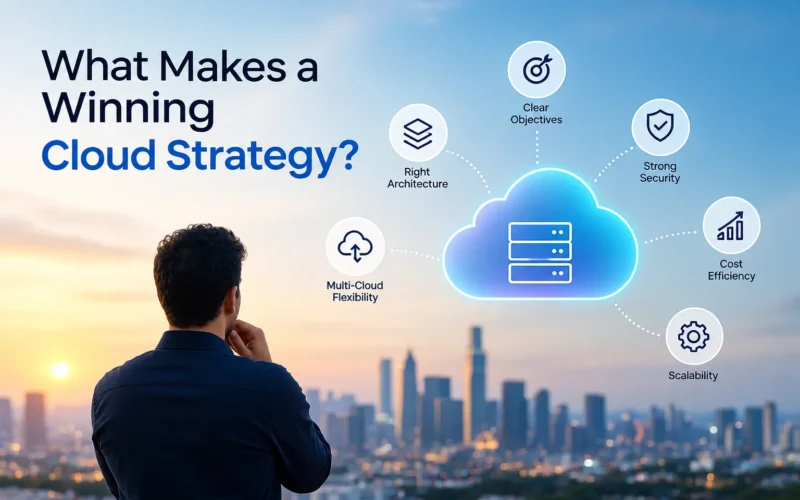

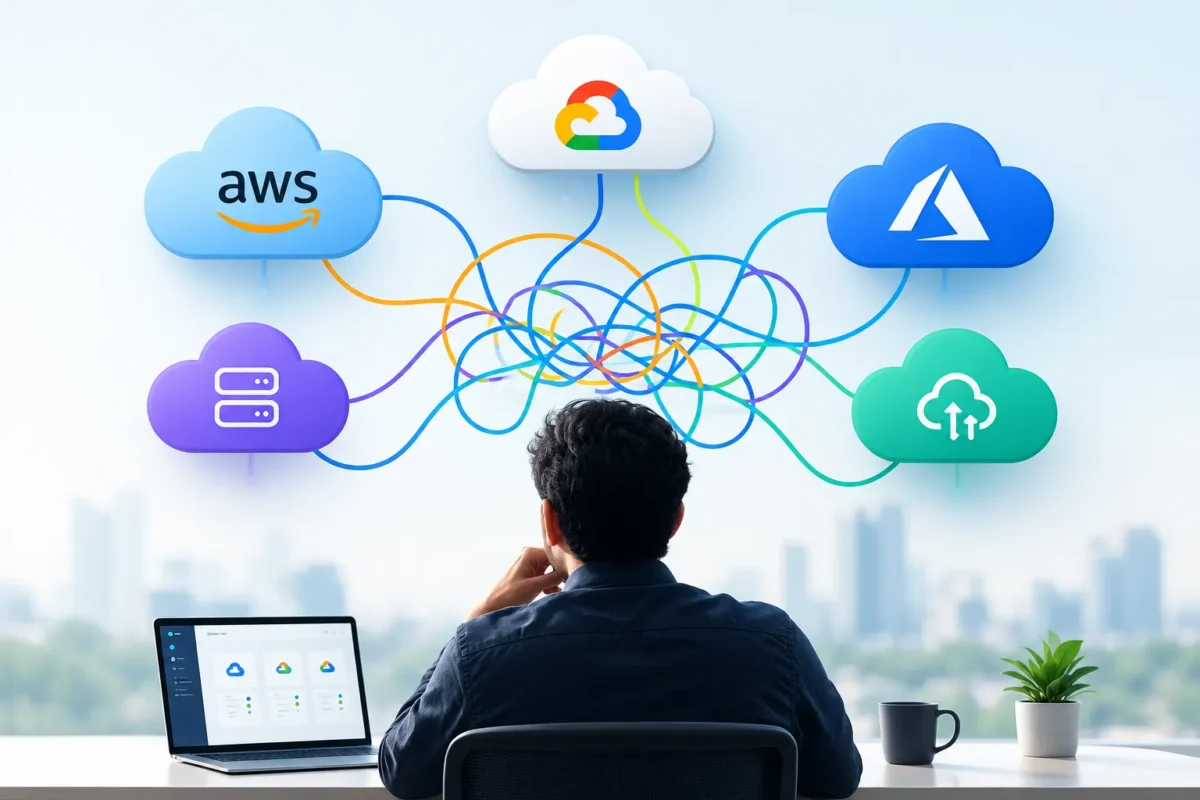
Multi-cloud is not automatically a strategy. It becomes strategic only when each workload, platform and control plane has a clear business, architecture, risk and economic reason to exist. This guide explains how accidental multi-cloud happens, and how workload placement, networking, governance and service choices decide whether multi-cloud creates value or simply adds operating overhead.
Very few organizations set out to create a complicated multi-cloud estate. Complexity usually arrives one decision at a time.
A product team selects a specialist service. An acquisition brings another cloud. A vendor requires a particular platform. A business unit buys SaaS with its own infrastructure. A development team needs something quickly outside the standard environment.
Each decision can make sense locally. Collectively, they can create a cloud landscape nobody intentionally designed. This is a core part of any sound technology strategy, because cloud decisions made without an enterprise view quickly become cost, risk and talent problems.
1. Understand How Accidental Multi-Cloud Happens
- Mergers and acquisitions introduce inherited platforms
- Business units or product teams make independent provider choices
- Specialist services pull workloads toward another cloud
- SaaS products introduce additional data and integration paths
- Projects bypass standard foundations to move quickly
- Legacy hosting and cloud environments coexist longer than expected
The first warning sign is often not the number of providers. It is the inability to explain why workloads are placed where they are. It is also one of the patterns we describe in why technology strategies fail.
2. Separate Intentional Multi-Cloud from Accidental Complexity
There are valid reasons to operate across more than one cloud or hosting model: regulation, data sovereignty, acquisitions, specialist capability, customer requirements, resilience, ecosystem alignment or existing strategic investments.
But every additional platform creates an operating cost across skills, identity, networking, observability, security, FinOps, support and governance.
The objective is not single-cloud or multi-cloud. It is intentional workload placement.
3. Make Workload Placement an Explicit Architecture Decision
Every workload should have a documented placement rationale. Use the questions below as a repeatable decision framework.
| Decision area | Questions to answer |
|---|---|
| Business criticality | What capability does the workload support, and how important is it to the business? |
| Data & regulation | Where can data reside, and what controls or jurisdictional requirements apply? |
| Performance & latency | Where does the workload need to be close to users, systems or data? |
| Platform capability | Does a provider offer differentiated capability that materially improves the outcome? |
| Skills & operations | Can the organization operate the platform reliably at the required scale? |
| Economics | What is the full cost, including people, tooling, connectivity, data transfer and governance? |
| Resilience | Does the placement strengthen or complicate continuity and recovery? |
| Portability & exit | What level of portability is genuinely required, and what is the exit path? |
If a workload cannot be explained through these factors, its placement may be historical rather than strategic. Structuring these decisions is a central part of digital product architecture and platform transformation.
4. Standardize the Foundation Without Pretending Every Cloud Is the Same
Multi-cloud does not mean duplicating one provider’s architecture in another. Each platform has different primitives, strengths and operating models.
What should be consistent are the enterprise expectations: identity, security, logging, policy, tagging, ownership, resilience, cost accountability and lifecycle management.
Landing-zone patterns can differ by provider while still implementing a common enterprise control model.
5. Treat Cross-Cloud Networking and Data Movement as First-Class Design Decisions
Multi-cloud complexity is often a networking and data problem before it becomes an infrastructure problem.
- Cross-cloud routing and connectivity
- DNS and service discovery
- Network segmentation and inspection
- Private connectivity and ingress/egress controls
- Latency between applications, services and data
- Data replication and transfer patterns
- Network observability and incident diagnosis
- Egress and connectivity economics
A technically elegant workload-placement decision can become operationally expensive if networking, data gravity and transfer cost are considered too late.
6. Decide What Should Be Cloud-Specific and What Should Be Shared
One of the most important multi-cloud decisions is where to accept provider-specific capability and where to standardize enterprise tooling.
| May remain cloud-specific | May benefit from shared enterprise capability |
|---|---|
| Managed databases and platform-native data services | Identity and access governance |
| Serverless and event services | Security monitoring / SIEM |
| Provider-specific AI and analytics capabilities | IT service management |
| Workload-native monitoring and diagnostics | Enterprise observability where cross-platform visibility is required |
| Cloud-specific deployment services | FinOps and technology-cost governance |
| Provider-native automation where it adds speed | Policy, compliance and architecture governance |
These are not fixed rules. The principle is to standardize where consistency creates value and use native capability where specialization creates greater value. For organizations building AI workloads on specific providers, this balance matters even more. See our approach to AI, data and intelligent enterprise transformation.
7. Avoid Portability for Portability’s Sake
Cloud-agnostic architecture can be valuable when the business has a credible need for portability. But portability has a cost.
- Additional abstraction layers
- Avoidance of useful provider-native capability
- More complex testing and release processes
- Duplicated operational patterns
- Broader skills requirements
- Higher platform and tooling overhead
The goal should be appropriate portability, not theoretical portability. Some workloads justify strong exit flexibility. Others create more value by using native capabilities deliberately.
8. Apply Common Security and Governance Expectations
Multi-cloud environments need consistent enterprise expectations even when implementation differs.
- Identity and privileged access
- Data classification and protection
- Security baselines and configuration policy
- Logging, monitoring and incident visibility
- Architecture principles and decision rights
- Cost ownership and tagging
- Resilience and recovery expectations
- Exception and lifecycle management
Common governance should reduce blind spots without forcing every platform into an identical technical design. Our cybersecurity, privacy, compliance and digital resilience work focuses on exactly this kind of consistent control model across mixed environments.
9. Make the Economics of Complexity Visible
The business case for multi-cloud should include more than provider price comparisons.
- Duplicate tooling and licenses
- Cross-cloud networking and egress
- Additional operational support
- Broader skills and certification requirements
- Multiple security and observability control planes
- Data movement and replication
- Governance and compliance effort
- Contract and vendor-management overhead
If the additional complexity does not create proportional business, risk or capability value, rationalization should be considered. This ties directly to the question of whether your technology investments are creating business value.
10. Include Sovereignty, Control and Exit Requirements Where They Matter
For regulated sectors, public services and geographically distributed enterprises, workload placement may also be influenced by data residency, jurisdiction, operational control and technology-sovereignty requirements.
These requirements should be translated into explicit architecture decisions rather than used as a vague justification for duplicate environments.
11. Rationalize the Estate Without Assuming Everything Must Consolidate
Discovering accidental multi-cloud does not mean the organization should force every workload onto a single provider. The first step is to make the rationale visible.
| Action | When it may apply |
|---|---|
| Keep | The workload has a clear strategic, regulatory, capability or economic reason to remain |
| Standardize | The workload can stay, but governance, identity, observability or cost ownership should become consistent |
| Consolidate | Duplicate platforms or tools can be reduced without losing important capability |
| Relocate | Another environment offers a materially better fit for business, risk or economics |
| Retire | The workload or platform no longer creates sufficient value |
Rationalization should simplify the estate while preserving deliberate differences that create real value. To see how this works in practice, read our case study on infrastructure and cloud consolidation.
A Practical Multi-Cloud Decision Model
Use this ten-step model to move from accidental complexity to intentional design.
- Business Need: Clarify why multiple environments are required.
- Workload Placement: Assess data, performance, capability, skills, resilience and economics.
- Landing Zones & Foundations: Apply common enterprise expectations while respecting provider differences.
- Networking & Data Movement: Design connectivity, latency, security and transfer economics explicitly.
- Native vs Shared Tooling: Choose where provider specialization or enterprise consistency creates more value.
- Security & Governance: Maintain common controls, ownership and decision rights.
- Economics & FinOps: Make the full cost of complexity visible.
- Portability & Exit: Design flexibility where it is genuinely required.
- Sovereignty & Regulation: Translate location, jurisdiction and control requirements into architecture.
- Rationalization: Keep, standardize, consolidate, relocate or retire based on evidence.
Multi-cloud creates value when intentional. It becomes expensive when accidental.
Final Thought
The strategic objective is not to minimize the number of clouds. It is to make sure every additional platform, tool and operating model has a reason to exist.
If leadership cannot explain why a workload runs where it does, what value the placement creates and how it is governed, that is a good place to begin the architecture conversation.
If you need senior guidance on cloud strategy and architecture, explore our fractional CTO services, learn more about SYNAPLAB, or contact us to discuss your cloud estate. You can also browse more articles in our Insights library and our full range of services.
Frequently Asked Questions
1. What is an accidental multi-cloud environment?
It is a cloud estate that grew across several providers or hosting models through local decisions, acquisitions, SaaS adoption or inherited platforms rather than a deliberate enterprise strategy.
2. Is multi-cloud a bad strategy?
No. Multi-cloud can be appropriate where regulation, specialist capability, customer requirements, resilience or existing investments justify it. The issue is unmanaged complexity, not the number of providers.
3. How should workloads be placed across clouds?
Workload placement should consider business criticality, data and regulation, latency, platform capability, skills, resilience, economics, portability and exit requirements.
4. Should organizations use the same tools across every cloud?
Not necessarily. Shared tools can improve enterprise consistency for identity, observability, FinOps or governance, while provider-native services may be better for workload-specific capabilities. The decision should be intentional.
5. Does multi-cloud require cloud-agnostic architecture?
No. Portability should reflect a real business requirement. Designing every workload for maximum portability can add cost and complexity while preventing teams from using valuable native capabilities.
6. How do you reduce accidental multi-cloud complexity?
Start by documenting workload placement, data flows, dependencies, tooling and ownership. Then identify what should be kept, standardized, consolidated, relocated or retired based on business value, risk and economics.