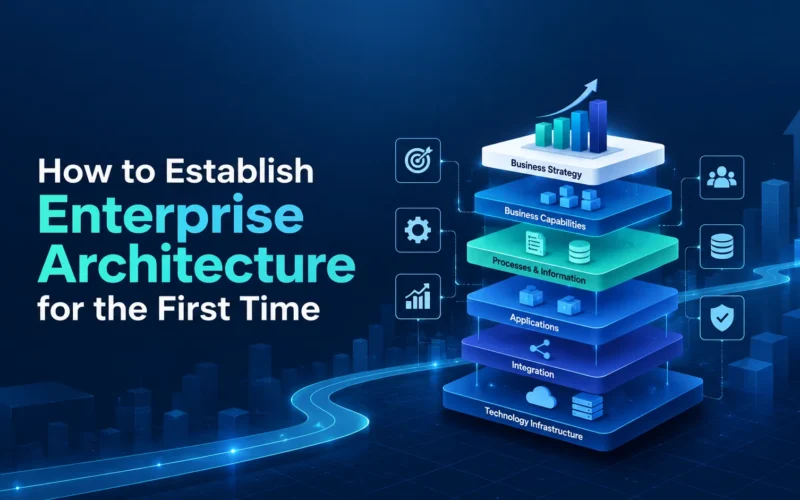


Enterprise Architecture (EA) is often judged by the target-state diagram it produces. That is the wrong measure. The real value of enterprise architecture lies in the quality of decisions it enables between today’s constraints and tomorrow’s business ambition: from future-state design to continuous transformation decisions.
This article explains how to move enterprise architecture beyond the target state, from business direction and capabilities through architecture decisions, transition architectures, roadmaps, governance and measurable outcomes. It builds on our wider thinking on building a technology strategy that delivers business value and why technology strategies fail.
1. Start Enterprise Architecture with Business Direction, Not Technology
Enterprise Architecture should begin with business context. Growth, customer experience, operational efficiency, resilience, regulatory change, new products, market expansion and AI adoption can all create different architecture priorities.
The first question is not “Which technology should we modernize?” It is “What must the organization become better capable of doing to deliver its business direction?”
Business capabilities provide the bridge from strategy to technology. They help leadership identify where change is required before selecting applications, platforms or infrastructure. A clear technology vision and roadmap starts from this same principle.
2. Understand the Current-State Constraints That Matter
A target state becomes meaningful only when it is compared with the current enterprise. EA needs enough visibility across capabilities, processes, applications, data, integration, technology and security to understand the constraints that influence important decisions. Useful questions include:
- Where is technology limiting an important business capability?
- Where are applications or platforms duplicated?
- Which technologies create lifecycle, security or operational risk?
- Where are data and integration dependencies slowing change?
- Where is technical debt reducing agility or increasing cost?
- Which existing investments remain fit for purpose and should not be changed?
The objective is not to document everything. It is to create enough transparency to make better decisions. This is also how leadership can answer whether technology investments are creating business value.
3. Make Enterprise Architecture Decisions Explicit
Between the current state and the future state are hundreds of decisions. Those decisions shape cost, complexity, resilience and transformation options for years. Typical architecture decisions include:
- Retain, modernize, replace or retire?
- Build, buy or partner?
- Consolidate or coexist?
- Enterprise platform or domain-specific solution?
- Rehost, re-platform or refactor?
- Centralize or federate?
EA should consider business value, strategic importance, technical fitness, risk, cost, dependencies, readiness and future direction together. A technically weak application supporting a differentiating capability may justify investment; a similar application supporting a low-value capability may be a retirement candidate.
For a real-world example of this kind of decision-making, see our infrastructure and cloud consolidation case study. Our digital product architecture and platform transformation practice helps organizations make these choices with business value and technical evidence side by side.
4. Define the Target State and the Transition Architectures
Very few organizations can move directly from today’s landscape to the desired future architecture. Operations must continue, budgets are finite, contracts have timelines and legacy dependencies cannot always be removed at once.
From Current State to Target State in Stages
- Current State: Existing capabilities, applications, data, integrations, platforms and constraints.
- Transition Architecture 01: Foundational changes such as cloud, security, identity, API enablement or initial rationalization.
- Transition Architecture 02: Platform consolidation, data foundations and priority modernization with dependencies resolved.
- Target State: The intended future architecture aligned to business direction and strategic capabilities.
Transition architectures make the target state executable. They recognize business continuity, dependencies and readiness rather than assuming a single jump to the future.
5. Turn Architecture into a Transformation Roadmap
Architecture decisions should translate into initiatives such as application rationalization, ERP modernization, cloud foundations, data transformation and AI readiness, integration modernization, cybersecurity improvement and digital-product enablement.
The EA contribution is not merely producing an initiative list. It is understanding relationships: what enables what, what can run in parallel, what must happen first, which programs share a dependency and where one enterprise capability can support several initiatives.
The Enterprise Architecture Decision Chain
6. Govern Execution Without Turning EA into a Bottleneck
Delivery introduces new information. Requirements evolve. Vendors propose alternatives. Budgets change. Technical constraints emerge. Architecture governance should therefore protect decision quality and traceability without becoming an approval bureaucracy. Effective EA governance includes:
- Architecture principles and standards
- Clear decision rights
- Design and architecture reviews
- Architecture Decision Records (ADRs)
- Exception management
- Technology lifecycle governance
Good governance asks whether the enterprise is still making decisions consistent with its business and architecture direction, not whether every project followed a diagram exactly. Many organizations lack the senior leadership to set this up; a fractional CTO can provide that oversight, and our guide to fractional vs interim CTO leadership models helps you choose the right one. Strong governance also depends on the right engineering organization and global delivery model.
7. Measure Enterprise Architecture Outcomes, Not Architecture Volume
The number of diagrams, standards or repository entries is not evidence that EA has created value. The more useful question is: what became better because architecture enabled a better decision? Outcome measures include:
- Reduced application or platform duplication
- Lower operating cost or avoided unnecessary investment
- Reduced technical debt and lifecycle risk
- Improved resilience and security
- Faster product delivery and integration
- Greater platform reuse
- Better access to trusted data
- Improved readiness for new digital and AI capabilities
Enterprise Architecture as a Continuous Decision System
Put together, Enterprise Architecture works best as a continuous decision system rather than a one-time design exercise:
- Business Direction: Clarify strategic priorities and intended business outcomes.
- Capabilities: Identify the capabilities that must improve, differentiate or scale.
- Current State: Understand the constraints, dependencies and technical condition that matter.
- Architecture Decisions: Make explicit choices using business value and technical evidence.
- Target and Transition States: Define the destination and realistic intermediate architectures.
- Transformation Roadmap: Translate decisions into sequenced initiatives and investments.
- Governance: Keep delivery decisions aligned while allowing justified change.
- Outcomes and Evolution: Measure value, learn from execution and evolve the architecture.
Key takeaway: The value of Enterprise Architecture is not the target-state picture. It is the quality of decisions the architecture enables between today’s constraints and tomorrow’s business ambition.
Enterprise Architecture should not simply describe the future. It should help the enterprise make better decisions on the way there.
Next Steps: Put Enterprise Architecture to Work
SYNAPLAB helps leadership teams turn technology strategy into executable architecture, roadmaps and governance. Explore our services, read more technology strategy insights and CTO advisory articles, browse our case studies such as technology strategy transformation, or learn more about us.