

Start with a business problem, not an architecture repository.
A first Enterprise Architecture capability should not begin by modeling the whole enterprise. It should begin with a decision the organization is already struggling to make, and demonstrate value from there.
Organizations rarely establish Enterprise Architecture (EA) because they want more architecture diagrams. Usually, technology complexity has reached a point where individual project decisions are creating enterprise-level consequences.
Applications have multiplied. Transformation programs compete for investment. Cloud adoption is expanding. Data is fragmented. Integration is becoming harder. Technical debt is slowing change. AI ambitions expose weaknesses across data, security, platforms and governance.
The natural reaction is to create an EA function and immediately build frameworks, repositories and standards. A more effective way to establish Enterprise Architecture is simpler: solve a real business and technology problem, prove the value of the enterprise view and expand deliberately. This is the same outcome-first thinking behind a strong technology strategy that delivers business value.
1. Establish Why EA Is Needed, and Why Now
Before defining frameworks or governance, leadership should be clear about the reason EA needs to exist. The trigger may be application complexity, ERP transformation, cloud adoption, M&A integration, data fragmentation, technology cost, cybersecurity risk, digital-product growth or AI readiness.
Instead of saying “We need an Enterprise Architecture practice,” frame the mandate in business terms: “We need a better way to understand enterprise dependencies and make technology investment decisions against our business priorities.”
That framing also helps answer a question many boards are asking: are your technology investments creating business value?
2. Secure Executive Sponsorship and Define Decision Rights
Enterprise Architecture operates horizontally across business units, products, applications, data, infrastructure, cybersecurity and transformation programs. Executive sponsorship gives the practice legitimacy to work across those boundaries.
Sponsorship should be paired with clear decision rights:
- What decisions belong to delivery teams?
- What belongs to domain architecture?
- When does a decision have enterprise impact?
- Who can approve an exception?
- Where should EA influence portfolio and investment planning?
This avoids both extremes: EA with no authority, and EA attempting to control every technical decision.
Define a Pragmatic EA Operating Model
Clarify who owns Enterprise Architecture, how enterprise, domain and solution architects work together, how business and technology leaders participate, and how architecture connects with portfolio, investment and delivery governance. The model can be centralized, federated or hybrid depending on organizational scale and maturity.
If you do not yet have senior architecture leadership in-house, models such as a fractional CTO can provide that sponsorship and direction. See our comparison of fractional vs interim CTO leadership models to choose the right fit.
3. Pick One Important Business Problem
Do not begin by modeling the entire enterprise. Select a problem where business importance and cross-enterprise complexity intersect. Good starting points include:
- A large application portfolio that needs rationalization and modernization decisions.
- ERP, CRM and digital programs changing shared capabilities at the same time.
- Cloud transformation that requires consistent platform, security and operating-model decisions.
- Fragmented data that is blocking analytics and AI ambitions.
- Rising technology cost with little transparency on duplication and lifecycle risk.
- An acquisition that needs business, application, data and technology integration.
A real problem creates a reason for EA to exist and gives leadership something concrete against which value can be measured.
4. Build a Minimum Useful Architecture Baseline
The objective is not to document everything. It is to understand enough to make the decision.
| Problem | Minimum useful baseline |
|---|---|
| Application rationalization | Capability, application, ownership, cost, business value, technical fitness and lifecycle. |
| Data / AI readiness | Business capability, information domains, systems of record, data flows, ownership, quality and controls. |
| Cloud transformation | Applications, workloads, dependencies, infrastructure, security, operating constraints and migration options. |
Over time, each EA initiative should leave behind reusable architecture knowledge. The repository grows because the organization is solving problems, not because documentation itself is the objective.
For data and AI problems in particular, our AI, data and intelligent enterprise transformation work shows how a focused baseline can unlock analytics and AI readiness. For cloud problems, see how we approached infrastructure and cloud consolidation.
5. Connect Technology to Business Capabilities
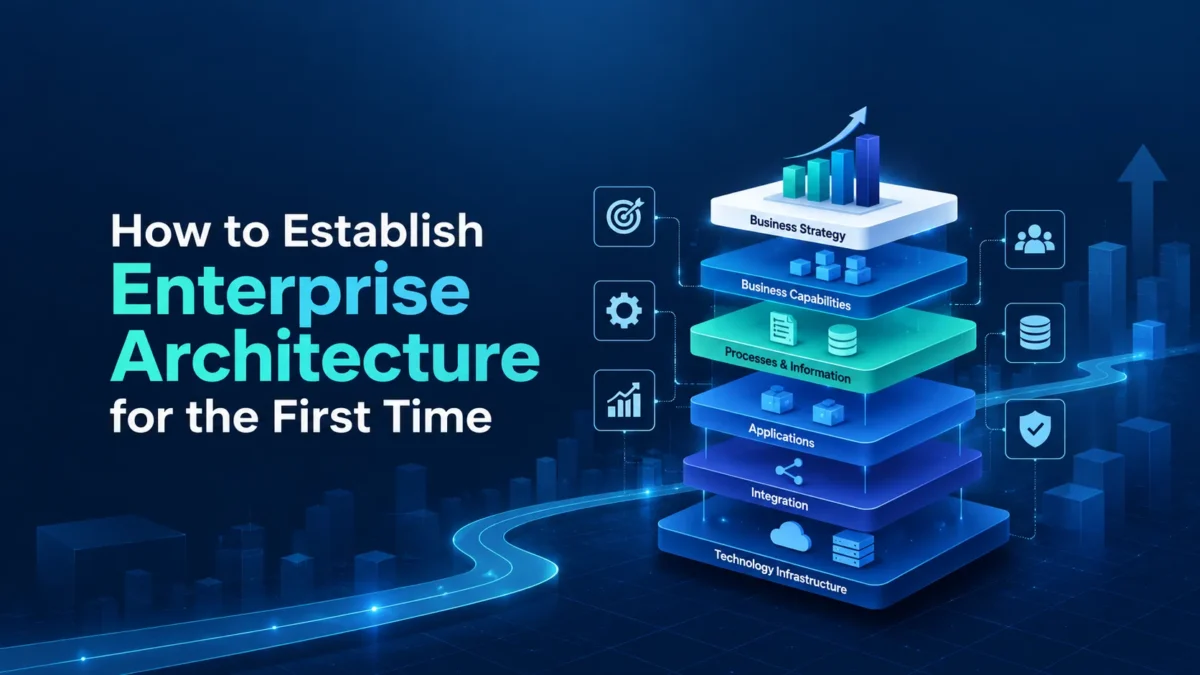
An application inventory alone is not Enterprise Architecture. Enterprise context appears when technology is connected to what the business needs to do. This is the traceability chain:
- Business Priority
- Business Capability
- Process / Information
- Application
- Integration
- Technology
This traceability helps leadership see which important capabilities are constrained, where systems overlap, which transformations affect the same capability and where investment can have the greatest strategic impact.
6. Make Architecture Decisions Visible
For the first initiative, document the important decisions, not merely the architecture. A simple decision view can make EA immediately understandable to executives.
| Decision | Evidence | Enterprise implication |
|---|---|---|
| Retire | Duplicate capability / low value | Avoid future cost and complexity |
| Modernize | High business value / poor technical fitness | Protect a strategic capability |
| Retain | Adequate business and technical fit | Avoid unnecessary change |
| Delay / sequence | Dependency not yet resolved | Reduce rework and transformation risk |
The decision chain should be explicit: Evidence → Decision → Investment / Action → Outcome.
7. Define Enough Future Direction to Guide Today’s Decisions
The organization does not need a perfect five-year architecture before EA can create value. It needs enough direction to improve today’s decisions:
- Architecture principles and strategic technology positions
- Target-state concepts for the priority domain
- Preferred integration and data patterns
- Security and identity expectations
- Technology standards where standardization creates value
- Current → transition → target states where sequencing matters
Architecture detail should increase where the organization is actively investing and making decisions. A clear technology vision and roadmap gives these target-state choices a business anchor, and our digital product architecture and platform transformation practice helps translate that direction into platforms teams can build on.
8. Turn Gaps Into Prioritized Initiatives and Early Outcomes
A gap does not automatically become a project. It should be considered alongside business value, risk, dependency, technical condition, cost, readiness and sequencing. The result should be a prioritized roadmap rather than a catalog of recommendations.
A new EA capability needs credibility more than completeness. Early value may come from identifying a redundant platform, exposing a critical dependency, preventing a duplicate investment, clarifying a migration sequence or defining a reusable capability.
Many strategies stall at exactly this step, which is why we wrote about why technology strategies fail and how to avoid it.
9. Introduce Lightweight Governance
Governance should grow with the maturity of the architecture capability. Start with the mechanisms that materially improve decisions, then expand as EA demonstrates value.
- Principles: Agree the small number of architecture guardrails that guide recurring decisions.
- Decision Rights: Clarify which decisions are local, domain-level or enterprise-level.
- Architecture Review: Review high-impact decisions at the right point in delivery.
- Decision Record: Capture rationale, alternatives, constraints and consequences.
- Exception Process: Allow justified deviations with clear ownership and review.
- Outcome Tracking: Measure whether decisions created the expected business and technology value.
Governance also depends on the people and delivery model behind it. Our engineering organization, talent and global delivery transformation service addresses how architecture practices fit into real engineering teams.
10. Measure, Reuse and Expand
The first initiative should leave behind two things: a business outcome and reusable enterprise knowledge. Capability maps, application relationships, principles, standards, decision records and dependency information can all be reused by the next initiative.
As the capability matures, standardize the architecture framework, repository and supporting tools where they improve reuse, traceability and governance. Tooling should support the EA capability, not become the starting point for it.
A Practical First-Time EA Journey
Here is the full journey at a glance:
- Why EA? Connect the mandate to a business and technology problem leadership already cares about.
- Executive Sponsorship: Create authority to work across organizational boundaries.
- Operating Model & Decision Rights: Clarify ownership, architecture roles and where EA influences enterprise-level choices.
- Priority Problem: Choose one meaningful, cross-enterprise problem.
- Minimum Useful Baseline: Build only the current-state views needed to make the decision.
- Capability Context: Connect technology to business priorities and capabilities.
- Architecture Decisions: Make evidence, trade-offs and rationale visible.
- Target and Transition Direction: Provide enough future direction to sequence change.
- Early Outcome and Governance: Demonstrate value and establish lightweight decision discipline.
- Measure, Reuse and Expand: Grow EA from proven value and reusable architecture knowledge.
Key Takeaway
Do not begin Enterprise Architecture by trying to document the enterprise. Begin by helping the enterprise make a decision it is currently struggling to make.
Start focused. Create value. Reuse what you build. Expand deliberately. Govern continuously.
Need Help Establishing Enterprise Architecture?
At SynapLab, we help leadership teams turn technology complexity into clear, business-led decisions. Explore our services, see real results in our case studies such as technology strategy transformation and digital transformation strategy, or learn more about us. Ready to talk? Contact our team.
Looking for more perspectives? Browse all SynapLab insights, or explore the Technology Strategy and CTO Advisory categories.