
A technology strategy should do more than describe a future technology environment.
It should help leadership answer:
Where are we going? What capabilities do we need? What should we invest in? What should we do first? And how will we know it is creating value?
A strong technology strategy connects business ambition to technology choices, then turns those choices into an executable roadmap.
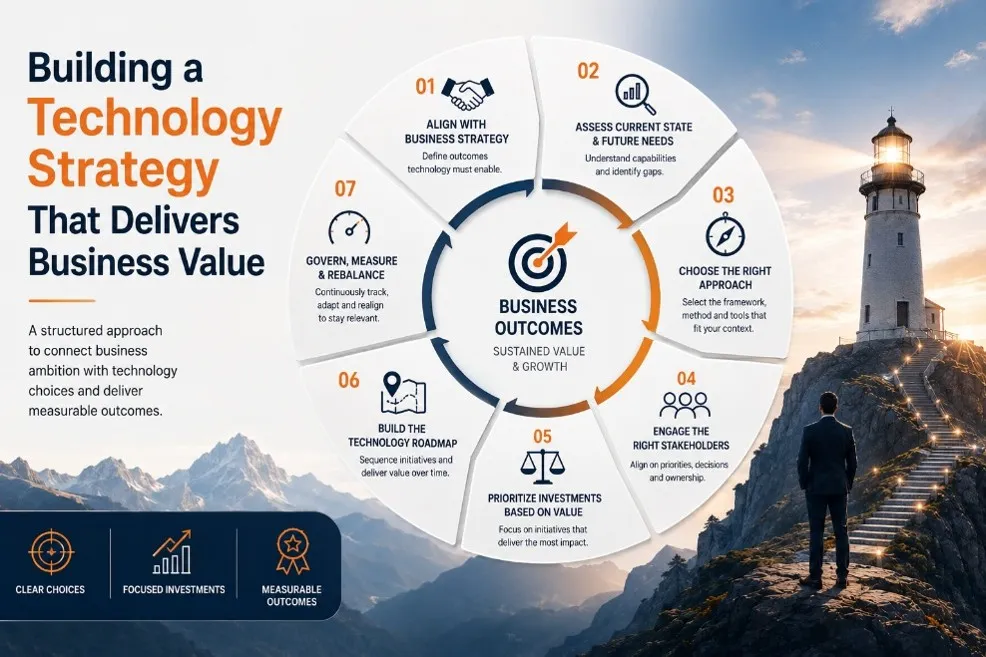
1. Align With Business Strategy and Objectives
Start with the business—not technology.
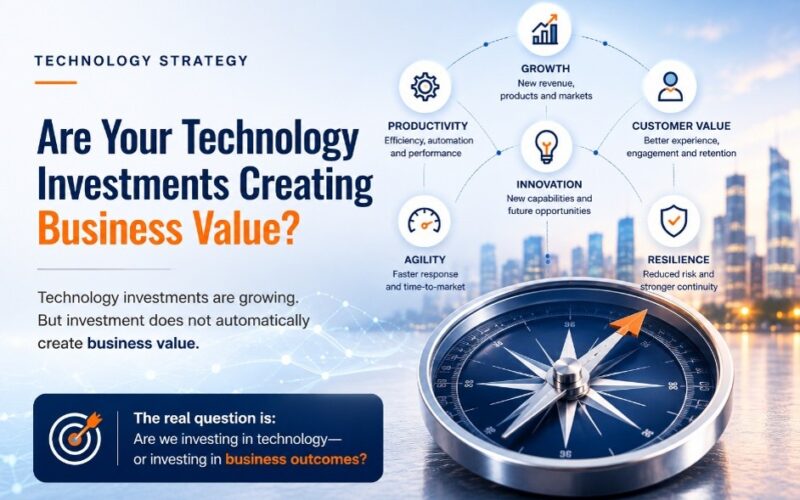
Understand the organization’s priorities across growth, efficiency, customer value, resilience and innovation. Translate those priorities into specific technology-enabled outcomes.
For example:
- Growth → enable new products, channels or markets
- Productivity → simplify and automate critical processes
- Customer value → improve experience and engagement
- Resilience → strengthen critical capabilities and reduce risk
The output should be business-linked technology objectives, not simply a list of technology projects.
What outcomes must technology enable?
2. Assess the Current State and Future Capability Needs
Before deciding where to go, understand where the organization is today.
Assess the current technology landscape, including applications, platforms, data, integration, infrastructure, security, engineering capabilities and the technology operating model.
Then identify the capabilities required to support the future business strategy.
The key questions are:
What capabilities do we have today?
What will the business need tomorrow?
Where are the gaps?
This provides the foundation for realistic technology choices and investment decisions.
3. Choose the Right Framework, Method or Tools
There is no single approach that fits every organization.
Choose the framework, method and supporting tools based on the organization’s size, maturity, complexity, industry and strategic objectives.
The purpose is not to follow a framework for its own sake. It is to provide enough structure to make consistent, transparent and actionable technology decisions.
Use the approach that fits the organization—not the other way around.
4. Engage the Right Stakeholders
Technology strategy cannot be created by the technology team alone.
Bring together the leaders who understand the business priorities, customer needs, financial constraints, operational realities, technology capabilities and risk environment.
Clarify:
- Who proposes?
- Who decides?
- Who funds?
- Who owns execution?
Early alignment is important because technology strategy involves choices and trade-offs.
Without clear decision rights, strategy can quickly become a collection of competing initiatives.
5. Prioritize Investments Based on Value
Resources are limited.
Not every initiative should move forward at the same time.
Evaluate potential investments based on factors such as:
- Strategic alignment
- Expected business impact
- Value timing
- Risk
- Feasibility
- Cost and resource requirements
- Dependencies
This creates a transparent portfolio rather than allowing priorities to be driven by the loudest stakeholder, the largest budget or the newest technology.
The objective is not to select the most initiatives.
It is to select the right combination of investments to support the business strategy.
6. Build the Technology Roadmap
The roadmap turns strategic choices into an executable sequence.
It should make clear:
What → When → Why → Who → Dependencies → Expected Outcome
A useful roadmap connects initiatives to business outcomes and shows how capabilities will evolve over time.
It should distinguish between:
- Near-term priorities — what needs to happen now
- Mid-term capabilities — what needs to be built next
- Longer-term direction — where the organization is heading
The roadmap should not become a fixed commitment.
As business priorities, market conditions and technology evolve, the roadmap should be reviewed and adjusted.
7. Govern, Measure and Rebalance
A technology strategy is not finished when the roadmap is approved.
Leadership needs a mechanism to determine whether investments are still aligned and whether expected outcomes are being achieved.
Regular reviews should consider:
- Business outcomes
- Investment performance
- Strategic alignment
- Delivery progress
- Emerging risks
- Changes in business priorities
- New opportunities
Some initiatives may need to be accelerated.
Others may need to change direction, be delayed or be stopped.
The strategy should therefore operate as a living management process, not a document that is created once and forgotten.
Connecting the Strategy
These steps provide the structure for developing a technology strategy. The depth and specific methods used at each stage should be adapted to the organization’s business context, technology maturity and strategic objectives.
A practical technology strategy connects the full chain:
Business Ambition → Current State → Capability Gaps → Strategic Choices → Priorities → Roadmap → Outcomes
| Strategy stage | Leadership question |
| Business alignment | What must technology enable? |
| Current state | Where are we today? |
| Capability gaps | What must change? |
| Strategic choices | What direction should we take? |
| Prioritization | What should we invest in first? |
| Roadmap | In what sequence will value be delivered? |
| Governance | Are we still creating the expected value? |
The strength of a technology strategy is not the sophistication of the document, framework or roadmap.
It is the organization’s ability to make better technology decisions, allocate resources deliberately and continuously connect technology execution to business outcomes.
A technology strategy becomes valuable when it turns business ambition into clear choices, focused investments and measurable outcomes.