
A technology strategy can look strong on paper and still fail to deliver the outcomes leadership expected.
The organization may have a clear vision, experienced leaders, significant investment and an ambitious roadmap.
Yet execution can still produce:
- Delayed outcomes
- Rising complexity
- Competing priorities
- Increasing costs
- Unclear business value
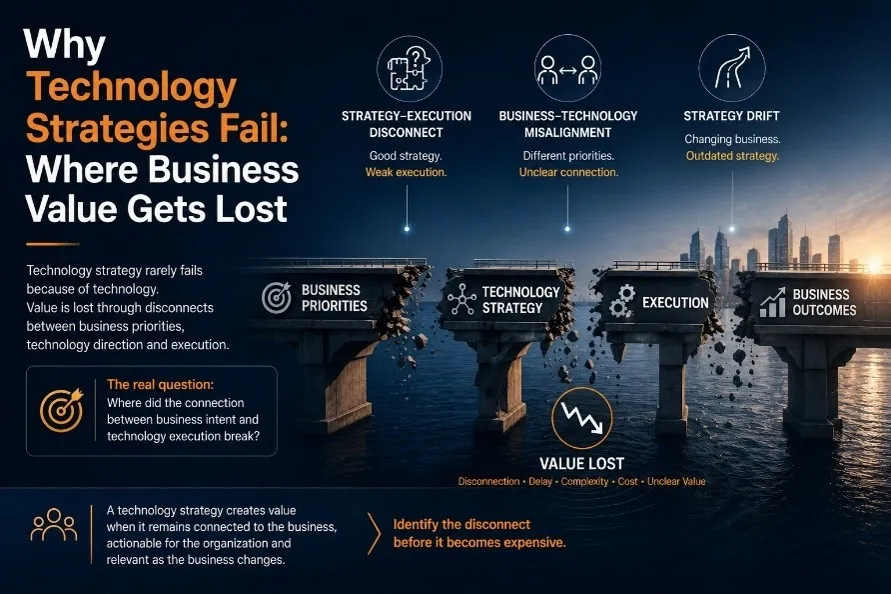
Technology strategy rarely fails because an organization lacks technology.
More often, value is lost through disconnects between business priorities, technology direction and execution.
Three patterns appear repeatedly.
1. Strategy–Execution Disconnect
Leadership may agree on what needs to change, but execution becomes fragmented when priorities are unclear, ownership is weak or too many initiatives compete for limited capacity.
Warning signs
- Too many competing initiatives
- Constantly changing priorities
- Unclear accountability
- Teams focused on delivery rather than outcomes
- Major initiatives repeatedly delayed
The result is a growing gap between:
What leadership intends to achieve
and
What the organization is actually delivering.
A strategy is not effective simply because it has been approved.
It must be understood, owned and actionable.
Leadership question:
Do our teams have the clarity, ownership and capacity to execute our technology priorities?
2. Business–Technology Misalignment
Business and technology leaders can agree that technology is important while still operating with different priorities.
The business may focus on growth, customer experience, productivity and market expansion.
Technology may focus on modernization, technical debt, platforms, infrastructure and standards.
All can be legitimate.
The problem occurs when the connection between them is unclear.
Warning signs
- Technology initiatives are difficult to connect to business priorities
- Business leaders question the value of investments
- Different functions build overlapping capabilities
- Technology decisions are driven mainly by technical preferences
- Business and technology teams define success differently
The result may not be poor technology.
It is technology that is not sufficiently connected to what the business needs most.
Leadership question:
Can we clearly explain how our major technology priorities support the business priorities that matter most?
3. Strategy Drift
Technology strategies are built on assumptions about the business, market, customers and technology.
Those assumptions change.
Business priorities evolve. Markets shift. Competitors respond. Regulations change. New opportunities emerge.
A strategy that remains unchanged while the business changes can gradually lose its relevance.
Warning signs
- Investments continue despite changed priorities
- Roadmaps are treated as fixed commitments
- New opportunities sit outside the technology direction
- Initiatives continue because they have already started
- Strategy reviews become reporting exercises rather than decision points
The organization may still be executing the strategy successfully.
But it may no longer be executing the right strategy.
Leadership question:
Are our technology priorities still based on the business realities that matter today?
Where Business Value Gets Lost
These three patterns affect the same chain:
Business Priorities → Technology Strategy → Execution → Business Outcomes
When that connection weakens:
- Strategy may no longer reflect business priorities.
- Execution may no longer reflect strategy.
- Technology may be delivered without the expected business outcome.
- Investments may continue after their original assumptions have changed.
What appears to be a technology problem can therefore be a strategy problem.
The better question is not:
“What went wrong with the technology?”
It is:
“Where did the connection between business intent and technology execution break?”
A technology strategy rarely fails because of one bad technology decision.
More often, value is gradually lost through three disconnects:
Strategy from Execution.
Technology from Business Priorities.
Strategy from Changing Business Reality.
Identify the disconnect before it becomes expensive.