

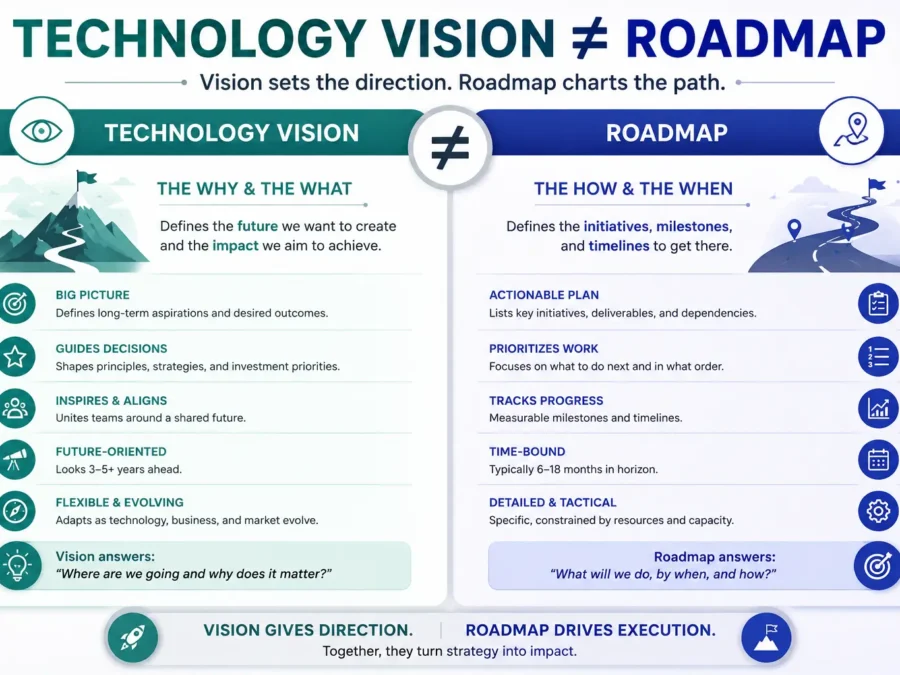
Why confusing vision with execution leads to fragmented decisions—and limits long-term impact.
Technology vision is often misunderstood.
It gets written as:
- a 12‑month plan
- an architecture blueprint
- or worse, a list of tools
But none of these represent actual vision.
The Real Problem
Organizations confuse direction with execution planning.
A roadmap answers:
What will we build next?
A vision answers:
What must technology consistently enable as we scale?
When these are treated as the same:
- strategy becomes reactive
- investments become short‑term
- execution loses cohesion
Where It Goes Wrong
Most “technology visions” are actually:
- delivery schedules
- budget‑aligned plans
- incremental improvements
If the vision fits neatly into the next 12 months:
it’s not a vision — it’s a project plan.
This leads to:
- fragmented initiatives
- short‑term optimization
- lack of strategic direction
What a Real Vision Does
A true technology vision:
- defines direction, not tasks
- aligns decisions across teams
- shapes long‑term capability
It acts as:
a lighthouse, not a map
Direction — not instructions.
Consistency — not sequencing.
Example: Manufacturing Context
A project roadmap might say:
- implement IoT sensors
- deploy analytics platform
- automate workflows
A real vision would say:
Enable intelligent, self‑optimizing manufacturing systems that improve operational efficiency, support human–machine collaboration, and deliver consistent performance at global scale.
What Changes When Vision Is Clear
- strategy becomes intentional
- roadmaps stop being reactive
- teams make better local decisions
- architecture gains consistency
- execution aligns naturally
Closing Insight
Technology leadership is not about predicting the future.
It is about setting direction before motion begins.
Alignment comes before execution.
Vision comes before roadmap.